






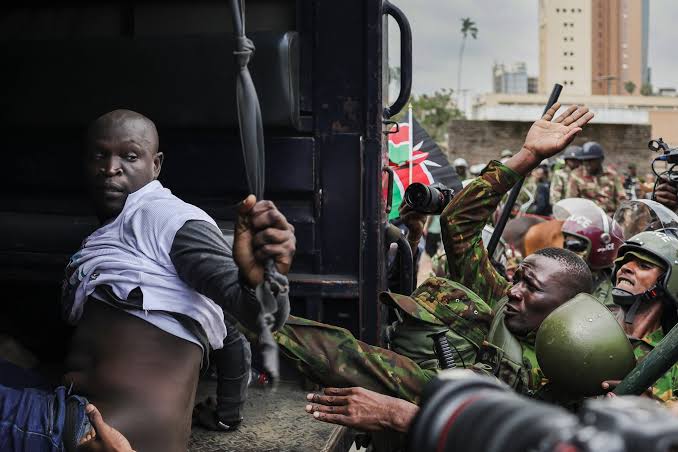

Activists turned up outside Jogoo House in Nairobi on Monday, August 17, demanding the resignation of Inspector General of Police Douglas Kanja over what they described as growing concerns about police brutality, deaths in custody and alleged violations of citizens’ rights.
The protesters, led by activist Julius Kamau, gathered at the offices as they called for greater accountability within the National Police Service.
Kamau chained himself to the gates of Jogoo House as he and other activists sought to draw attention to their demands.
The protest became tense when police officers confronted the activists. Kamau was seen chained to the gate as a heated exchange developed between him and officers who appeared determined to stop the demonstration from continuing.
Several activists were also arrested during the incident. By the time of publication, six protesters had reportedly been taken into custody as police moved to prevent the group from addressing the media and explaining their concerns.
The activists said their protest was not only about the leadership of the National Police Service but also about a series of incidents that have raised questions about the conduct of security agencies.
They pointed to reports of abductions, alleged enforced disappearances and deaths in custody, including cases associated with young people who took part in protests.
The protesters also raised concerns over violence witnessed in Homa Bay on Sunday during activities linked to the Linda Mwananchi convoy. Armed youths reportedly disrupted the convoy, attacked people and assaulted journalists.
At least one person was also reported dead following the chaos.
The events in Homa Bay have triggered questions about the response of security agencies and whether enough was done to prevent violence and protect people taking part in public and political activities.
For the activists outside Jogoo House, the Homa Bay incident was part of a wider concern about the ability of the police to protect citizens and respond fairly when tensions rise.
They called for independent investigations into cases of alleged abductions and deaths in custody and demanded accountability where security officers are accused of violating the rights of citizens.
The calls for Kanja to leave office are not new. The Inspector General has previously faced pressure over several incidents in which critics accused the police of failing to protect citizens during political activities or being involved in cases of alleged brutality.
In July, former Deputy President Rigathi Gachagua called for Kanja’s resignation following violence reported in Ol Kalou, Nyeri County. Voters and journalists were reportedly attacked during the incident. Interior Cabinet Secretary Kipchumba Murkomen, however, defended Kanja and said the Inspector General continued to enjoy public confidence.
Kanja also faced calls to resign in April following the reported assault of Vihiga Senator Godfrey Osotsi in Kisumu. Western Kenya MPs led by Butere MP Tindi Mwale called for Kanja to appear before Parliament and said he should resign if he could not guarantee the safety of Kenyans.
Monday’s protest has therefore added to the growing public debate surrounding the leadership of the National Police Service.
The activists are demanding answers over several issues, including alleged abductions, deaths in custody, police brutality, political violence and the protection of citizens during public events.
The arrests outside Jogoo House have also added another point of concern for the protesters, who wanted an opportunity to speak publicly about their demands. The circumstances surrounding the arrests were not immediately clear.
At the time of publication, the National Police Service had not issued an official statement on the protest or the reported arrest of the six activists. It was therefore unclear what charges, if any, had been placed against those arrested or how police intended to respond to the wider demands raised by the protesters.
The demonstration has once again placed the office of the Inspector General under public scrutiny as activists and other critics continue to call for greater accountability within the country’s security agencies.












Add Comment