






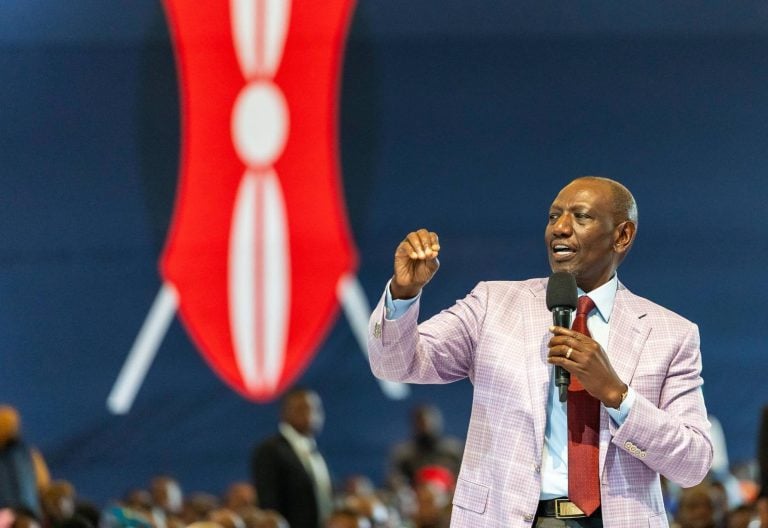

President William Ruto has suffered a legal setback after the High Court in Nairobi declared unconstitutional the task force he established to audit Kenya’s public debt.
The ruling, delivered on Thursday, July 23, found that the committee had been assigned responsibilities that fall under the constitutional mandate of the Office of the Auditor-General.
Justice Lawrence Mugambi ruled that auditing public debt and pending bills is a function reserved for the Auditor-General and cannot be carried out by a committee appointed through a presidential directive.
The decision followed a petition filed by activist Magare Gikenyi and other petitioners, who challenged the legality of the task force.
The petitioners argued that the executive had exceeded its constitutional powers by creating a body to perform duties already assigned to an independent constitutional office.
They also claimed that the task force was formed without public participation and that the process used to appoint its members did not meet constitutional requirements on merit, inclusivity and transparency.
In its defence, the government maintained that the task force was constitutional and that President Ruto had acted within his powers.
State lawyers argued that the committee was intended to serve as an advisory body to help the President in policy formulation and the execution of his duties.
They insisted that the executive has the authority to establish such bodies when necessary.
However, the court disagreed with that position. Justice Mugambi stated that although the President enjoys broad executive powers under the Constitution, those powers are not unlimited.
He noted that every action taken by the executive must remain within constitutional boundaries and can be subjected to judicial review.
The judge emphasized that constitutional offices have clearly defined mandates that cannot be transferred or duplicated through executive action.
According to the court, allowing a presidential task force to conduct an audit of public debt would undermine the constitutional role of the Auditor-General.
The ruling comes three years after President Ruto appointed an eight-member task force to carry out a forensic audit of Kenya’s growing public debt.
The committee was formed as part of efforts to provide greater transparency on how borrowed funds had been used and to recommend measures for managing the country’s debt burden.
At the time of the appointments in July 2024, the President directed the team to submit a comprehensive report within three months.
He said the audit would help Kenyans understand the extent of the country’s debt, how public resources were spent and what steps could be taken to improve debt management.
Among those appointed to the task force were Philip Kaikai, Shammah Kiteme and Vincent Kimosop. Former Law Society of Kenya President Faith Odhiambo was also named to the committee but later declined the appointment.
The High Court ruling now casts doubt on the legality of the entire initiative and reinforces the constitutional limits on executive authority.






Add Comment