






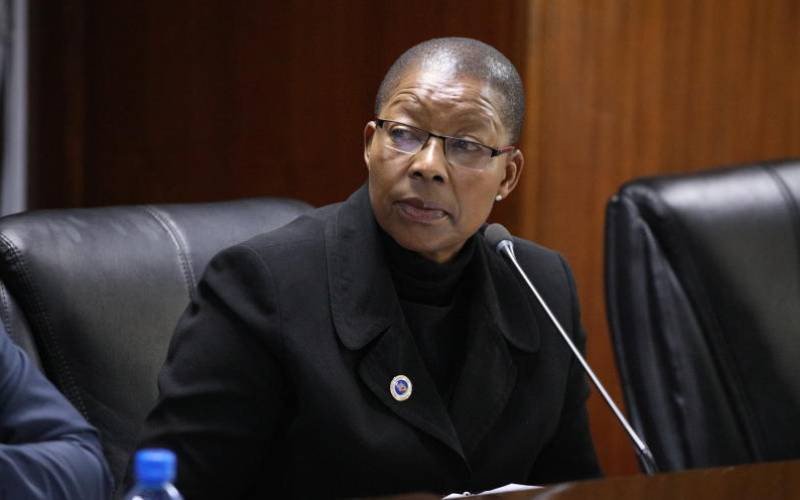

The Office of the Attorney-General, under the stewardship of Kenya’s first female Attorney-General Dorcas Oduor, has found itself at the centre of a mounting credibility crisis.
A Public Service Commission audit, ordered by the courts and dated June 30, 2026, has exposed what many legal observers are describing as systemic failures in recruitment and institutional governance, raising serious questions about the office’s commitment to the very constitutional principles it exists to defend.
The audit’s findings are deeply troubling. It reveals that during a recruitment exercise conducted between April and June 2024, a significant number of candidates were shortlisted for positions they were not qualified for, and in some cases, had not even applied for. Eighteen candidates were shortlisted for Legal Clerk Assistant IV positions without meeting the advertised qualifications, while twenty-seven faced a similar situation for State Counsel II roles.
More alarmingly, fourteen Legal Clerk Assistant IV applicants and eight State Counsel II applicants appeared on shortlists despite never having been on the original long list, suggesting they had never applied in the first place.
The most serious revelations concern the appointment of seven individuals as State Counsel II who lack the fundamental credentials required for anyone practising law in Kenya, including a Bachelor of Laws degree, a postgraduate diploma from the Kenya School of Law, or admission as an advocate.
These are not minor administrative oversights. State Counsel advise on multibillion-shilling government contracts, defend the Republic in complex commercial litigation, and support the state’s position in constitutional disputes.
An unqualified appointee in such a position represents a direct liability to the public purse, particularly at a time when court awards against the state had already more than doubled to approximately Sh44 billion by January 2025.
The interview panel’s conduct during this process has also come under scrutiny. According to the audit, the panel never disclosed a pass mark, never ranked candidates, and never explained why successful names were chosen over others.
The final appointment list presented to the Attorney-General’s desk carried none of the scores, criteria or standards that were supposed to justify who got the job.
Multiple versions of applicant lists circulated internally, with one recording qualifications and another stripping them out entirely, which the commission treated as evidence of a process designed to obscure rather than document.
This recruitment scandal did not emerge in isolation. It occurred against a backdrop of repeated constitutional overreach by the State Law Office.
In May 2025, Justice Byram Ongaya of the Employment and Labour Relations Court quashed more than two hundred promotions carried out inside the Attorney-General’s office, ruling that the exercise violated constitutional requirements on fair competition, merit, gender balance and ethnic diversity.
The court went further, declaring unlawful the very instrument that had enabled the internal restructuring, amendments smuggled into the Statute Law Act that had created an Advisory Board chaired by the Attorney-General herself with authority over recruitment and promotion functions that constitutionally belong to the Public Service Commission.
The court’s language left little room for charitable interpretation, describing the attempt to detach the Attorney-General’s office from PSC oversight as resting on a misleading premise. Justice Ongaya ordered the PSC to investigate the State Law Office and report by December 2025, which produced the damaging audit now making headlines.
A parallel move to sideline the PSC in appointments to parastatals and public universities was separately struck down by the High Court in December 2025, with two rulings reaching the identical conclusion that the Attorney-General’s chambers repeatedly tried to pull hiring and promotion power away from the constitutional body designed to police it.
The credibility problem has extended beyond personnel matters to include contempt of court allegations. In May and June 2026, the High Court issued conservatory orders halting a controversial United States-linked Ebola quarantine and treatment facility under construction at Laikipia Airbase, pending determination of a constitutional petition filed by civil society organisations.
Health Cabinet Secretary Aden Duale ignored the order, leading Justice Patricia Nyaundi to find him in continuing contempt of court on June 22, 2026.
Attorney-General Dorcas Oduor was named alongside Duale in the underlying contempt application, accused of failing to comply with the court’s directives and withholding disclosure of the bilateral agreement with the United States.
While the court ultimately declined to make a separate contempt finding against the Attorney-General on that limb, the episode fit a wider institutional posture of an office characterised more by defensive crouching against accusations of constitutional overreach than by reformist promise.
Perhaps the most reputationally corrosive episode of Oduor’s tenure has involved a succession dispute over the estate of the late James Boro Karugu, Kenya’s second Attorney-General.
The Directorate of Criminal Investigations concluded that a will and trust deed submitted for probate bore forged signatures, implicating Peter Gachuhi, a senior partner at the elite firm Kaplan and Stratton, among six suspects in what the DPP characterised as a coordinated criminal scheme.
Oduor’s office entered the matter formally on February 17, 2026, filing grounds of opposition that dismissed a petition from Gachuhi and his co-petitioners as incompetent and argued that a pending succession cause created no bar to criminal investigation and prosecution.
The conflict-of-interest thread is difficult to ignore, given that Kaplan and Stratton had previously represented Karugu personally in sensitive matters while he was alive.
The Attorney-General’s decision to contest the petitioners’ position has dragged the State Law Office into a case that exposes the kind of insider dealing, blurred professional boundaries and elite impunity that her own chambers are simultaneously accused of tolerating in their hiring halls.
Taken together, these controversies form a pattern of miscalculation and double dealing that is hard to dismiss as mere noise.
The Statute Law Act gambit assumed that sweeping restructuring of constitutional human resource functions could be smuggled through an omnibus bill with minimal scrutiny, that an Advisory Board chaired by the Attorney-General would produce cleaner outcomes than the Public Service Commission, and that the courts would not notice or would not care.
All three assumptions failed. The result was over two hundred quashed promotions, a second nullified attempt to seize parastatal appointment powers, and now a forensic audit exposing appointees who never applied and counsel who never qualified.
The double dealing is not necessarily personal corruption in the classic sense of money changing hands, though the PSC’s warning about exposure of public funds to misuse leaves that door open pending further investigation.
Rather, it is structural: an office that publicly commits to reform, rule of law and merit while operating internal processes that evade documentation, evade competitive scrutiny, and evade the very oversight body the Constitution designates for the task.
It is an Attorney-General who stood before Parliament promising to fix delays and restore integrity to the justice system, while her own chambers could not produce a pass mark, a ranked list, or a credible explanation for who got hired and why.
Dorcas Oduor’s defenders point to her three decades of prosecutorial service, her role shaping the Proceeds of Crime and Anti-Money Laundering Act, and the historic weight of being Kenya’s first female Attorney-General.
None of that record answers the specific findings now sitting in a Public Service Commission report bearing the date June 30, 2026. Unqualified State Counsel do not become qualified by institutional pedigree.
Ghost applicants do not retroactively apply because the person who hired them has an impressive resume.The Public Service Commission’s report gives the government and the Judicial Service Commission, on which Oduor herself sits as a constitutional member, a clear mandate: review every irregular appointment flowing from the recruitment exercise, establish accountability for a process that operated outside the constitutional and statutory framework, and ensure future hiring in the State Law Office cannot again produce appointees who do not hold a law degree advising the Republic of Kenya on multibillion-shilling matters.
Whether that accountability reaches beyond the recruitment panel to the office that oversaw it remains the open question hanging over Sheria House.
The courts have now ruled against the Attorney-General’s chambers twice on the same underlying pattern of constitutional overreach, found the Health Cabinet Secretary in contempt in a case naming her as co-respondent, and are separately weighing forgery allegations against a law firm whose partner sat opposite her office in a succession dispute this year.
For an Attorney-General whose appointment was framed as a milestone for gender equality and institutional reform, the record accumulating fourteen months in tells a different story, one of miscalculation, evasion and an office that has repeatedly had to be told by the courts what the Constitution already required it to know.












Add Comment