





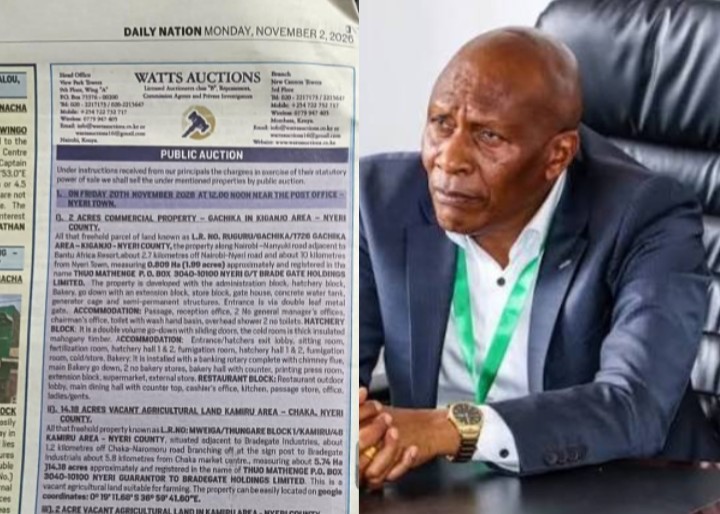

The Daily Nation of Monday, 2 November 2026 carried a stark public auction notice from Watts Auctions. On Friday, 20 November 2026 at noon, near the Post Office in Nyeri Town, several properties linked to Thuo Mathenge popularly known as Wanguku or Noo Wanguku and Bradegate Holdings Limited will go under the hammer.
This is the same Thuo Mathenge who is positioning himself as a serious contender for Nyeri Governor in 2027. The man who once sold himself as a self-made billionaire, a major employer, and the chicken king of Nyeri is watching core pieces of his business empire being lined up for forced sale.
The timing is impossible to ignore.
What Exactly Is Going Under the Hammer?
The notice lists five properties:
– A developed 2-acre commercial property in Gachika, Kiganjo area (L.R. No. Ruguru/Gachika/1726).
This is no empty plot. It contains the administration block, hatchery block, bakery, store, gate house, water tank, generator house and other structures. It also includes the restaurant section with outdoor lobby, supermarket, kitchen, offices and dining areas.
This is the heart of the Bradegate operation that made Wanguku famous.
– 14.18 acres of vacant agricultural land in Kamiru area, Chaka (L.R. No. Mweiga/Thungare Block 1/Kamiru/48).
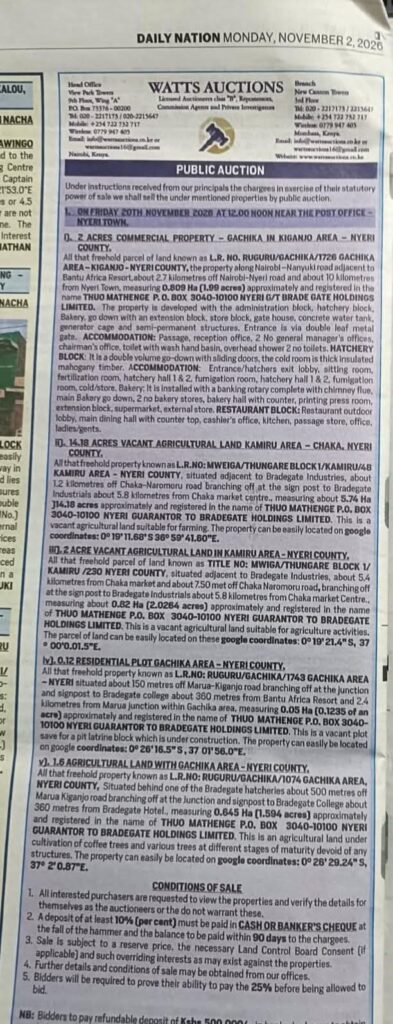
– Another 2-acre vacant agricultural parcel nearby in Kamiru (Title No. Mweiga/Thungare Block 1/Kamiru/230).
– A small 0.12-acre residential plot in Gachika area.- 1.6 acres of agricultural land in Gachika under coffee and various trees (L.R. No. Ruguru/Gachika/1074).
All are freehold, registered either in Thuo Mathenge’s name or with him as guarantor for Bradegate Holdings Limited. Google coordinates are even provided so potential buyers can locate them easily.
A 10 per cent deposit is required on the fall of the hammer, balance within 90 days, and bidders must prove they can pay before being allowed to bid.
There is also a refundable deposit of KSh 500,000 to obtain bidding documents.
This is not a quiet private sale. It is a public auction ordered by the chargees exercising their statutory power of sale.
In plain language: the banks or lenders have lost patience.
A Familiar Story of Debts and Auctions
This is not the first time Thuo Mathenge’s properties have faced the auctioneer’s hammer. In 2017, 2018 and especially 2021, similar notices appeared over debts running into hundreds of millions of shillings to banks including Jamii Bora, Family Bank and I&M Bank.
The commercial property housing Brade Gate Poultry Industries has been in and out of distress sales for years. The man who built a name on poultry farming, a hatchery, a slaughterhouse that could handle tens of thousands of birds, a resort, a bakery and related businesses has repeatedly struggled to service the loans that financed the expansion.
Courts have previously dismissed his attempts to stop earlier auctions.
Now, in late 2026, the same pattern has returned while he campaigns for the highest office in Nyeri County.
The Political Ambition Meets Financial Reality
Thuo Mathenge has run for Nyeri Governor before in 2013, 2017 and 2022.
In 2022 he lost heavily to Mutahi Kahiga, managing just over 81,000 votes. After the 2022 loss he accepted an appointment from President Ruto as chair of the Kenya Agricultural and Livestock Research Organisation (KALRO) board in late 2024.
That appointment was revoked in July 2026. Days later he joined Rigathi Gachagua’s Democracy for the Citizens Party (DCP) and made clear he is targeting the 2027 gubernatorial race.
The public image he projects is that of a successful industrialist who understands business and agriculture, a man who can create jobs and turn Nyeri around. Yet the auction notice tells a different story.
A candidate who cannot keep his own flagship commercial property and surrounding lands free from forced sale is now asking voters to hand him control of county resources, county budgets and county procurement.
Why This Matters for Nyeri Voters
The hard question writes itself. When a man’s private businesses keep landing on the auction list, what happens when he gains access to public money?
The suspicion among many ordinary people is straightforward: some politicians seek office not to serve, but to solve their personal cash-flow problems using the county’s cheque book.
Loans can be refinanced, suppliers can be paid with public contracts, land deals can be structured, and “development” projects can be steered in directions that quietly help friends and companies linked to the office holder.
Wanguku’s slogan has long been “No Wanguku” “It’s just chicken.” The joke now writes itself.
The chicken empire is once again on the chopping block, and the man who built it is asking Nyeri to make him governor.
Voters have a right to demand answers. How much is currently owed?
Which lenders are forcing this sale? Has any of the debt been restructured recently?
What guarantees exist that county resources will not be used, directly or indirectly, to rescue private liabilities?
Silence or vague talk about “business challenges that every entrepreneur faces” will not be enough.
The Bigger Pattern
Kenya has seen this movie before. Businessmen who struggle to manage their own balance sheets suddenly discover a passion for public service when the banks start calling.
They campaign on their “proven track record” in the private sector while the private sector is busy advertising their assets for sale.
The pattern is not unique to Nyeri, but Nyeri residents are the ones who will live with the consequences if they ignore the warning signs.
Thuo Mathenge still has the right to vie. He still has the right to explain himself. What he does not have is the right to expect voters to look away from a public auction notice published in the national newspaper two weeks before the hammer falls.
The properties listed are not minor side plots. They sit at the centre of the business identity he has sold to the public for years.On 20 November 2026, near the Nyeri Post Office, the auction will take place whether the political class wants to discuss it or not.
The people of Nyeri will then have more than a year to decide whether a man whose own commercial holdings keep facing the auctioneer’s gavel is the right person to manage their county’s future.











Add Comment