






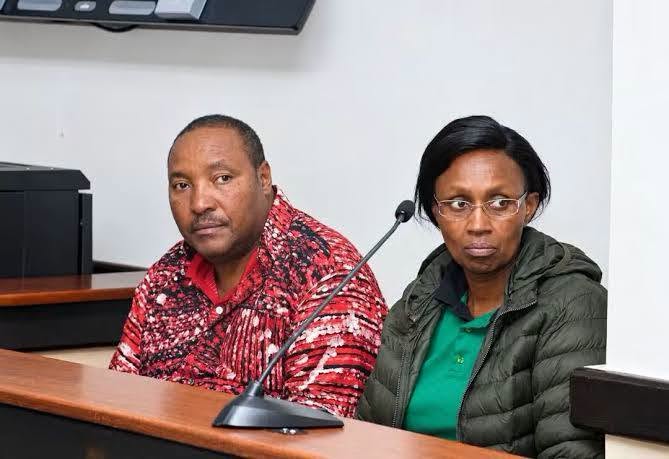

Former Kiambu Governor Ferdinand Ndung’u Waititu and his co-accused have been slapped with additional fines following their conviction for money laundering in a case linked to a Ksh588 million road construction contract awarded by the Kiambu County Government.
The Milimani Anti-Corruption Court imposed fines on Waititu, his wife Susan Wangari Ndung’u, and Charles Chege Mbuthia and his wife Beth Wangechi Mburu, alongside two companies connected to the case.
The penalties include fines of up to Ksh36 million, with prison terms ranging from two to 13 years for individuals who fail to pay.
The Ethics and Anti-Corruption Commission (EACC) welcomed the sentences, describing the outcome as an important step in the fight against corruption and money laundering in Kenya.
The latest penalties followed a High Court decision delivered on October 14, 2026, which reinstated money laundering charges against Waititu and his co-accused.
Under the new sentences, Waititu was fined Ksh21 million or 13 years in prison if he fails to pay. Mbuthia received a fine of Ksh28 million or 13 years in prison, while Mburu was fined Ksh6 million or six years in prison.
Waititu’s wife, Susan, was fined Ksh2 million or two years in prison in default.The court also fined Testimony Enterprises Limited Ksh36 million and Saika Two Estate Ksh24 million.
Saika Two Estate is owned by Waititu and his wife.
The case dates back to 2019 when the EACC launched investigations into allegations that the Kiambu County Government had irregularly awarded Testimony Enterprises Limited a Ksh588 million contract during the 2017/2018 financial year.
The contract involved upgrading gravel roads to bitumen standards in Thika, Limuru, Gatundu North, Juja and Ruiru sub-counties.
Investigators examined how the contract was awarded and the role played by the individuals and companies involved. The case later resulted in several convictions over offences linked to the procurement process and the handling of suspected proceeds of corruption.
On February 12, 2025, Waititu and his co-accused were convicted of various offences, including conflict of interest, dealing with suspected property, abuse of office, fraudulent procurement practices and wilful failure to comply with procurement laws and regulations.
Waititu was sentenced to 12 years in prison or ordered to pay a fine of Ksh52,749,000 in connection with those offences.
His wife, Susan, received a one-year prison sentence or a fine of Ksh500,000. Mbuthia was sentenced to 11 years in prison or fined Ksh297,048,110, while Mburu received three years in prison or a fine of Ksh1.4 million.
Luka Mwangi Wahinya was also sentenced to seven years in prison or fined an amount recorded in the case details as Ksh million, although the exact figure was not provided.
Following the additional money laundering penalties, the cumulative fines and default prison terms for the four individuals were updated.
Waititu now faces total fines of Ksh73,749,000 or 13 years in prison in default. His wife faces fines totalling Ksh2.5 million or two years in prison, while Mbuthia faces cumulative fines of Ksh325,048,110 or 13 years in prison.
Mburu’s total fines stand at Ksh7.4 million or six years in prison if she fails to pay.
The High Court ordered the custodial sentences to run concurrently, meaning the applicable prison terms will run at the same time rather than one after another.
The court also directed Testimony Enterprises Limited and Saika Two Estate to pay their respective fines within 14 days. Failure to comply will result in the amounts being recovered in accordance with Section 334 of the Criminal Procedure Code.
The EACC said the outcome was significant in efforts to strengthen accountability for money linked to corruption and improve the country’s response to financial crimes.
The case also comes at a time when Kenya is working to address concerns raised by the Financial Action Task Force (FATF) as part of efforts to exit its grey list. The FATF identifies weaknesses in countries’ systems for combating money laundering and other financial crimes.
The commission’s position is that pursuing such cases is necessary to ensure that public resources are protected and that individuals and companies found guilty of corruption-related offences face the consequences provided under the law.












Add Comment