






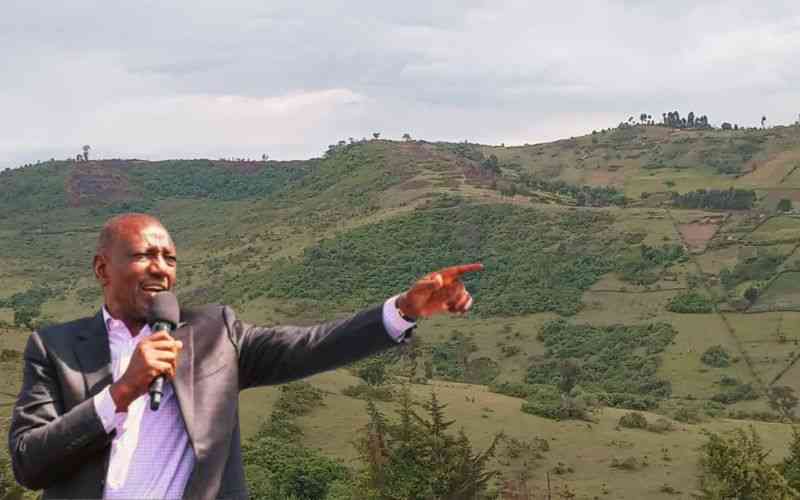

Controversy has surrounded the Sh2.6 billion compensation programme for families evicted from the Mau Forest, with about 15,000 families saying they were left out while 13,000 others received payments.
Of the roughly 28,000 families registered by the government as affected, only half have so far been compensated. The issue has created a long-running humanitarian problem that has stretched over more than two decades and is now emerging as a point of tension ahead of the August 2027 general election, with attention focused on how President William Ruto’s administration handles the remaining claims.
President Ruto announced the release of the Sh2.6 billion in August 2026 during a visit to Narok County. The money was meant for families affected by earlier evictions carried out under former President Uhuru Kenyatta’s administration, when Ruto served as Deputy President.
Each of the 13,000 families was to receive Sh200,000. Officials described the payment as a way to close a difficult chapter and help people rebuild their lives away from the forest. Some families who had been living in temporary camps had earlier received higher amounts of around Sh300,000, after which their structures were taken down.Many of those who received the latest payments have said the money is not enough. They argue that Sh200,000 cannot buy alternative land and also build a house for a family.
Some compared it unfavourably with earlier compensation given to other groups of internally displaced people under previous governments, who reportedly received higher cash amounts plus land allocations of between one and a half and two and a half acres.
The victims who feel short-changed have described the latest payout as too little and too late.
The situation has grown more complicated because a large number of registered families say their names were missing from the final list of beneficiaries. Some of these families returned to parts of the Mau Forest area and set up tents after learning they had been left out. Local officials ordered them to leave the protected forest land and instead present their complaints through proper government channels.
Narok County Governor Patrick Ole Ntutu and the county commissioner have both urged the affected households to remain patient while authorities review the lists and correct any errors or omissions. Officials have acknowledged that some households were not included and have said the government is looking into the problems that arose during the verification and payment process.
Claims have also circulated that some people who were not genuine victims managed to get onto the beneficiary lists. A lawyer representing some of the families has called for a review to ensure the right people are paid.
The Directorate of Criminal Investigations has questioned several individuals suspected of encouraging the excluded families to take matters into their own hands. Opposition figures have also spoken on the matter, urging the government to address the humanitarian needs of those still waiting.
The Mau Forest evictions have a long history. Successive governments have carried out operations to clear people from the forest in efforts to protect the important water catchment area. Many families lost homes and farmland and spent years in camps or temporary settlements.
Over time the issue became tied to politics, with promises made during election campaigns. President Ruto had pledged during the 2022 campaign period to resolve the matter once in office. The recent payments were presented as fulfilment of that commitment, yet the remaining disputes mean the matter is far from settled.
Government officials have stated that they continue to engage with the communities and local leaders to find lasting solutions. The Internal Security Principal Secretary has said the administration is working through existing structures to deal with the outstanding grievances.
At the same time, the lifting of a caveat on certain private lands near the forest has been presented as another step to ease restrictions that had affected farming activities.For the families still waiting, the uncertainty continues.
Many have lived with the effects of displacement for years and now face the prospect of another election cycle in which their situation may again become a subject of political debate.
The coming months will show whether the remaining claims can be verified and addressed in a way that reduces the tension surrounding the Sh2.6 billion programme.
The scale of the original displacement and the number of people still seeking recognition mean the issue is likely to remain sensitive in the South Rift region as Kenya moves closer to the 2027 polls.












Add Comment