





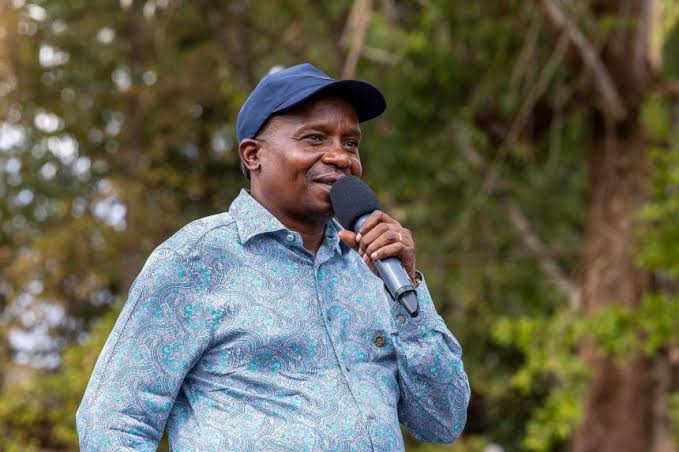

Deputy President Kithure Kindiki’s office is under scrutiny over pending bills totalling Sh552.6 million for the 2025/2026 financial year, raising questions about how the debts accumulated despite the office’s commitment to prioritise payment whenever the National Treasury releases funds.
In a session on Tuesday, Members of the National Assembly Departmental Committee on Administration and Internal Security questioned the office’s financial management, demanding explanations for the outstanding bills and conflicting figures contained in government reports.
The MPs were considering the office’s proposals under the 2027 Budget Policy Statement when they warned that the continued accumulation of unpaid expenses could point to financial commitments being made without adequate budget allocations.
Loima MP Protus Akuja questioned the difference between the Sh552.6 million the office reported and the Sh569.8 million indicated in the Public Administration and International Relations Sector Report.
“According to this report, in the financial year 2025/2026, the pending bill for this particular State Department was Sh552.6 million. Against another report by the Public Administration and International Relations Sector Report, which shows a pending bill of Sh569.8 million. Can they be able to provide a reconciled and verified schedule because these are two contradicting reports,” Akuja said.
Committee chairman and Narok West MP Gabriel Tongoyo questioned why the office continued accumulating pending bills despite treating them as the first charge whenever funds were released.
He said the problem could be linked to expenditure commitments made without approved budget allocations rather than delayed disbursements by the Treasury.
“You have been having carryovers or spillover of pending bills. For 2025/2026, about Sh440 million, and for 2026/2027, was it Sh500 million? The big problem, in my view, is all these pending bills that are incurred because of lack of provision of funds, as opposed to lack of liquidity,” Tongoyo said.
“It is better to have a pending bill because maybe the National Treasury delayed the releases, but it means there was no budget provided for. So you went ahead, procured services, and these are recurrent expenses which were not supported in the budget. Then we end up carrying some recurring pending bills. Maybe, was it even necessary in the first place? And what do we do so that we don’t continue to have such a situation?”
The office’s Chief Finance Officer told MPs that pending bills were prioritised whenever funds were received, adding that the office regularly requested additional allocations from the Treasury to reduce the outstanding amounts.
“In the Office of the Deputy President, we ensure that pending bills form the first charge on the allocated budget. To reduce the pending bills, we always request the National Treasury to consider us for additional funding to reduce the bill,” the finance officer said.
Officials further disclosed that the outstanding balance had since dropped to approximately Sh150 million, with a significant proportion of the bills attributed to hospitality expenses.
Tongoyo, however, insisted that the office needed measures to prevent repeated spending commitments that were not supported by approved budgets.
Principal Administrative Secretary Moses Mbaruku said the office would prioritise constitutional responsibilities, including the Intergovernmental Budget and Economic Council (IBEC), engagements with development partners and duties assigned to the Deputy President by the President.
“Reduced budget definitely will go to the extremely binding issues, the constitutional issues like issues on IBEC. We have to deal with that and the issues on our development partners, and finally all the issues that will be delegated to the Deputy President by the President, because that’s the Constitution,” Mbaruku said.
“So we deal with the constitutional issues first. Then we can now get to other issues after we have done with the constitutional matters.”
The committee also questioned the office’s expenditure after officials reported that 44 per cent of its budget had been utilised in the first quarter.Saku MP Ali Dido Rasso, the committee’s vice-chairperson, said the rate was worrying because government spending usually increases in the second and third quarters.
He sought an explanation on how the office would avoid exhausting its funds and seeking additional spending authority under Article 223 of the Constitution.
Mbaruku clarified that the 44 per cent expenditure included recurrent spending and was driven partly by pending bills, normal operations, coordination of high-level government engagements and the Deputy President’s supervision activities across the country.
“We have indeed used 44 per cent, and there is a possibility of running out of money. One of the reasons why we have spent that much within the first quarter and part of the second quarter is because of the issues of pending bills, which are of course of concern to both this committee and us,” he said.
Mbaruku added, “The first charge, as we have rightly reported, is on the pending bills, which we are again servicing. Then the second thing is that we have still continued with the normal operations.”
He said the office had requested Sh7 billion but expected to receive about Sh4 billion, which would cover only slightly more than half of its financial requirements.
The MPs also sought details on funds disbursed to government agencies following meetings convened by the Deputy President to coordinate preparations for the anticipated El Niño rains.
Rasso questioned how the money would be accounted for if the expected rains failed to materialise and whether unused funds would be returned.
“What happens if El Niño does not happen? What happens to those monies? Are they going to be returned? How will those monies be accounted for? And maybe you can share with us how much has been disbursed so far,” he posed.
Mbaruku said the Deputy President’s office only coordinated the meetings, while the money was released directly to the relevant State departments and organisations.
He added that the National Treasury would determine how unused funds would be handled but could not provide the total amount disbursed.











Add Comment