




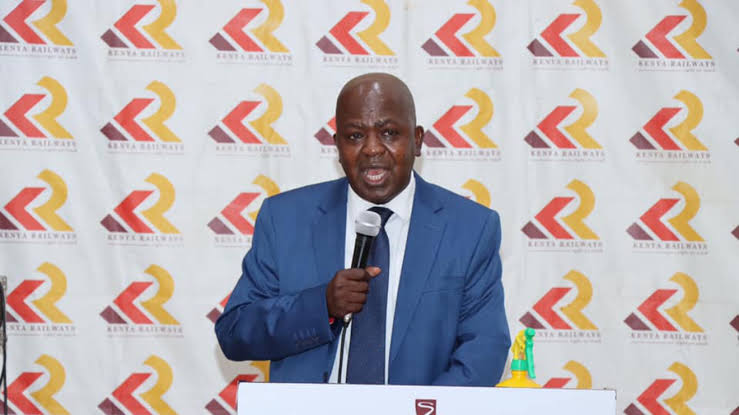

A High Court petition has been filed seeking the removal of Kenya Railways Managing Director Philip Mainga from office, claiming he has remained in the position beyond his lawful tenure.
The case also seeks a full audit of the Standard Gauge Railway (SGR) project, investigations into procurement concerns and the release of key contracts and financial records linked to the multibillion-shilling railway.
The petition, filed by public interest litigant Wahome Mucunu, argues that Mainga’s continued stay in office is unconstitutional and has weakened public confidence in Kenya Railways.
According to the court documents, Mainga was appointed Managing Director in 2018 and should have completed the maximum allowable two terms of three years each by 2024.
The petitioner argues that keeping the same leadership beyond the legal term goes against the principles governing state corporations and accountability in public service.
“Under the prevailing governance principles applicable to the state corporations, the office of the Managing Director is not meant to be occupied indefinitely,” the public interest litigant argues in his petition.
He adds that Mainga’s tenure in office ought to have lapsed in 2024.Mainga has been named as an interested party in the proceedings, while the Kenya Railways Board, the Attorney General and the Transport Cabinet Secretary have been listed as respondents.
The petition also revives long-standing questions surrounding the Standard Gauge Railway, one of Kenya’s biggest public infrastructure projects.
It argues that concerns over procurement, transparency, accountability and the use of public funds have never been fully addressed despite years of public debate.
The court filing states, “Transparency International this year in March allegedly indicated that SGR was a high risk project, with a 4.9 out of 5 corruption risk score.”
The petitioner further argues that “the project has equally generated sustained public debate concerning transparency, accountability, value for money, public participation, procurement practices and debt sustainability.”
He also states that “the people of Kenya, being the ultimate financiers of the project through taxation and public borrowing, possess a legitimate constitutional interest in the manner in which the project was conceived, procured, financed and implemented.”
According to the petition, Transparency International also found that public institutions, including Kenya Railways, repeatedly failed to provide information requested by accountability groups and researchers.
“The assessment concluded that the responses received were insufficient to facilitate effective public oversight,” he alleges.
He further states that “all material times relevant to this Petition, the first interested party, Mr Phillip Mainga, has served as the Managing Director of Kenya Railways Corporation.”
He also notes that “the office of Managing Director constitutes the highest executive office within the Corporation and carries overall responsibility for the administration, management and operational control of the affairs of the Corporation.”
The petition says members of the public, civil society organisations, governance experts and accountability institutions have continued raising concerns over the management of major Kenya Railways projects.
“Such concerns have centered on the adequacy of procurement procedures, transparency of contractual arrangements, disclosure of project costs and effectiveness of oversight mechanisms,” he states.
He maintains that “these concerns have never been adequately addressed in a manner capable of restoring public confidence.”
Appearing before Justice David Mburu, the petitioner wants the court to declare that the continued failure to disclose details of the SGR contracts violated the Constitution. He is also seeking a declaration that Mainga should have vacated office after completing his lawful tenure.
At the same time, the petition asks the court to compel the Kenya Railways Board to begin the process of appointing a new Managing Director while ordering an audit of all SGR contracts.
“The continued tenure of the Kenya Railways Managing Director is unconstitutional,” he argues.
He contends that Mainga’s leadership “has undermined public confidence in the corporation and is inconsistent with the principles of integrity, accountability and transparency under Chapter Six of the Constitution.
“He further contends that “procurement processes surrounding the SGR lacked openness, competitiveness and cost effectiveness as required under Article 227 of the Constitution and the Public Procurement and Asset Disposal Act.
“Among the orders sought are the publication of all SGR contracts, loan agreements, procurement records and audit reports. The petitioner also wants the Ethics and Anti Corruption Commission to investigate procurement and governance concerns surrounding the project, while the Auditor General carries out a special audit together with a comprehensive forensic review of procurement and expenditure.The application further seeks conservatory orders barring Mainga from making procurement, contractual, financial or policy decisions on behalf of Kenya Railways until the case is heard and determined.
He argues that “the office of the managing director and chief executive officer of KRC is a public office that carries significant public trust, involves the administration of public resources and entails the exercise of public authority.
“He contends that “despite completing the permissible two terms of three years each, Mr Mainga continues to serve in office and exercise the powers of the position, including signing contracts, entering into agreements and undertaking public functions.
“The petitioner warns that “unless the court intervenes, the continued exercise of authority by Mr Mainga could result in further constitutional violations.”
He is also asking the court to direct the Kenya Railways Board to appoint an acting Managing Director pending the hearing and determination of the case while compelling the corporation to disclose all contracts and agreements signed by Mainga during the disputed period.
“The managing director’s office is a senior public position involving the management of public assets and resources,” he argues.
He insists that “holders of the office are constitutionally required to demonstrate integrity, accountability, transparency and professionalism at all times.”
He maintains that Mainga has exhausted his tenure but continues to exercise the powers of the office despite several major public projects being undertaken during the disputed period.”
The KRC Board has a constitutional and statutory duty to ensure that individuals occupying senior offices meet the requirements of leadership, integrity and accountability,” the petitioner says.
He argues that “occupying the office beyond the lawful tenure is unconstitutional, unlawful, null and void.
“He states that “appointments to such senior public offices are typically made on fixed term contracts that may be renewed subject to performance and compliance with lawful renewal procedures.
“He further argues that “the applicable tenure for the KRC managing director is two renewable terms of three years each, unless a lawful extension, renewal or reappointment is undertaken in accordance with the relevant public service and state corporation governance frameworks.
“The petition also seeks disclosure of appointment documents, employment contracts, renewal approvals, board resolutions, gazette notices, performance contracts and all contractual instruments executed during the disputed period.
The High Court is expected to issue directions once all the respondents have filed their responses.
The outcome of the case could have significant implications for leadership at Kenya Railways, the management of the SGR project and accountability in state corporations.









Add Comment