






Governor Gladys Wanga of Homa Bay has mastered the art of public relations. Her image is that of a trailblazer, the first female governor of her county, a leader who speaks passionately about transformation.
Her press releases are filled with promises of modern markets, better roads, and improved healthcare.
But behind the glossy photos and the carefully crafted statements lies a financial catastrophe that is swallowing Homa Bay whole.
The numbers do not lie, and they paint a picture of a county that is failing its people while its governor poses for photo opportunities.
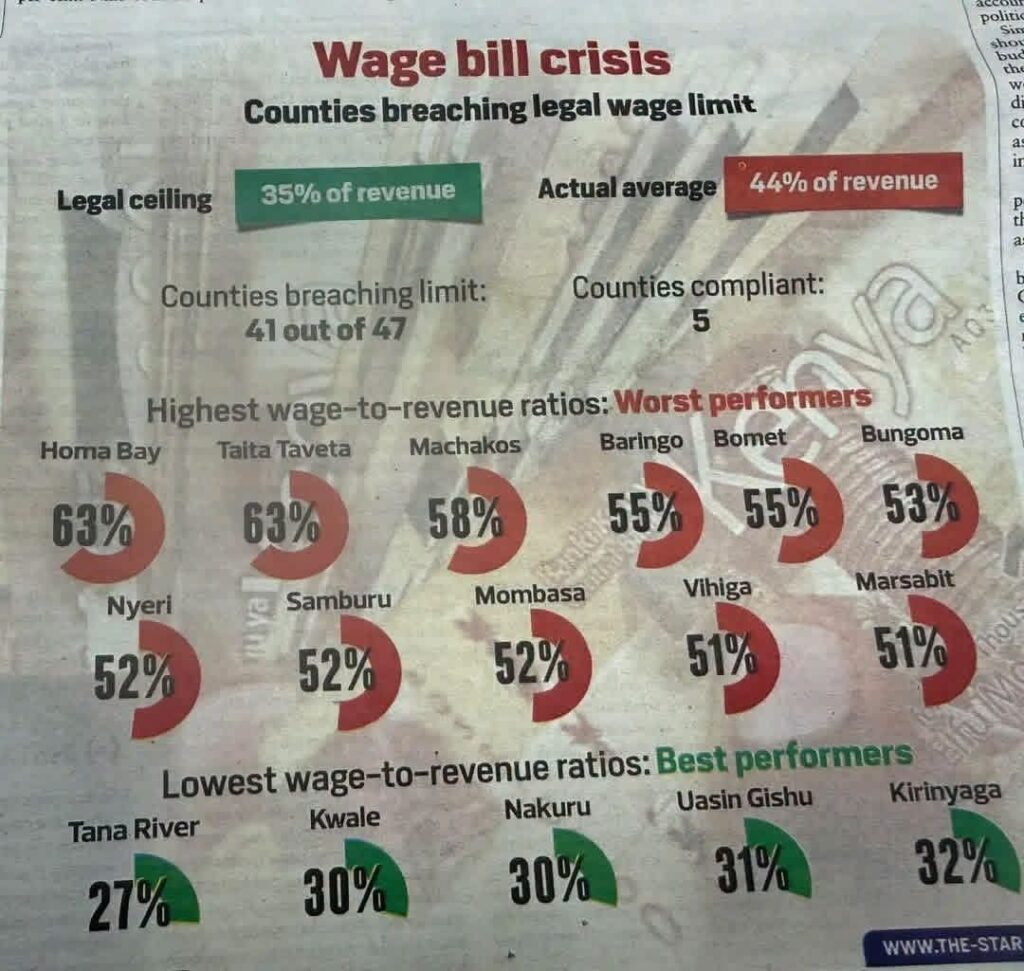
The most shocking evidence comes from the county’s wage bill. The law is clear and simple: no county in Kenya should spend more than 35 percent of its total revenue on salaries and allowances.
Homa Bay has not just broken this law; it has completely destroyed it.
The county currently spends a staggering 63 percent of its revenue on wages, making it the worst performer in the entire country.
To put this in perspective, for every one hundred shillings that Homa Bay collects, sixty-three shillings never see a single development project.
They are eaten up by payroll costs, leaving almost nothing for roads, hospitals, schools, or water supplies.
This is not governance; this is financial suicide.
The situation becomes even more disturbing when you look at the county’s development budget.
While the wage bill consumes nearly two-thirds of all revenue, the county spends only 31 percent of its development allocation on actual projects.
That means even the little money set aside for building things is not being fully used.
Meanwhile, the county is drowning in pending bills of Sh1.52 billion, according to the Auditor-General’s report for the 2024/25 financial year.
Of this amount, Sh1.09 billion is more than a year old, and a shocking Sh700 million has been outstanding for over three years.
Suppliers who delivered goods in good faith are left unpaid, their businesses collapsing while the county government continues to spend recklessly on itself.
One supplier, identified only as Kamanga Junior, shared a heartbreaking story. A friend of his supplied computers and printers worth Sh7.3 million to county dispensaries.
The goods were delivered, the paperwork was completed, but years later, the county has not paid a single shilling.
This is not an isolated incident. It is a pattern of negligence that is destroying small businesses and livelihoods across the county.
While Governor Wanga claims to be fighting for the people, her administration is strangling the very businesses that keep the local economy alive.
Perhaps the most embarrassing episode came when Governor Wanga herself was caught in the web of financial mismanagement. Shortly after taking office, she commissioned an audit by PricewaterhouseCoopers to identify ghost workers on the county payroll.
The move generated glowing headlines and positioned her as a reformer. The audit uncovered 1,786 irregular employees, including 556 people with no appointment letters, 479 who could not be traced, and three minors who were being paid from public funds.
The audit estimated these ghosts were costing the county Sh300 million every year.
Wanga promised to implement the recommendations immediately and clean up the mess.
Three years later, nothing has changed. Senator Moses Kajwang’, who chairs the Senate Public Accounts Committee, confronted Governor Wanga again in September 2025 with updated data showing 1,327 ghost workers still on the payroll.
The wage bill, far from falling, had grown to nearly 55 percent of revenue. But the most humiliating revelation was yet to come.
Senator Kajwang recalled that during the review of the audit, Governor Wanga’s own name appeared on the list of staff with incomplete documentation.
She initially accepted the report, the Senator said, “until she found her name on the list.” The report had to be taken back for flaws.
This is not a clerical error; it is evidence of a system so broken that even the governor’s own records are irregular.
The human cost of this crisis is now visible in the streets. In March 2026, all 751 nurses employed by the county went on strike.
They are demanding promotions that have been denied for up to ten years, the redesignation of colleagues who completed further studies, and the payment of salary arrears that date back to August and September 2022.
Some nurses have not been paid for months. The county has also failed to remit third-party deductions for loan repayments, leaving nurses in debt to banks.
While Governor Wanga attends high-level ODM meetings and poses for photos, the nurses are on the streets, and patients are suffering.
This is the real cost of fiscal irresponsibility.
Instead of facing the Senate committee to account for these failures, Governor Wanga has twice skipped their meetings.
She was in Nairobi the day before her scheduled appearance, attending a different Senate committee session on climate action, but when the Public Accounts Committee convened to discuss the wage bill and pending bills, her seat was empty.
She went to the media to share photos of her meeting on climate action but remained silent on the financial emergency crippling her own county.
This is a leader who is more interested in appearances than accountability.
Homa Bay is not just breaking the law; it is breaking the trust of its people.
The county is spending more on itself than on the people it is supposed to serve.
The nurses are unpaid, the suppliers are collapsing, and the development projects are stalled.
Governor Gladys Wanga’s tenure is a case study in how a carefully constructed PR image can mask a reality of fiscal negligence, unpaid debts, and a crippling wage bill that leaves no room for the development she so loudly proclaims.
The people of Homa Bay are not seeing transformation; they are seeing a county government that is devouring its own future.
And until the governor chooses accountability over appearances, the crisis will only deepen.












Add Comment