





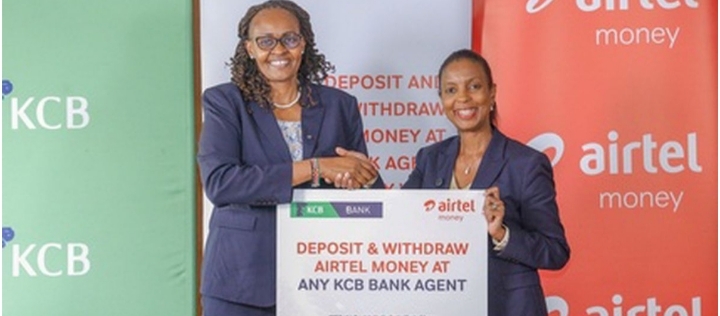

When the photographs were taken, everything looked perfect. Two managing directors, seated across a polished table, pens in hand, signing an agreement that would supposedly transform Kenya’s financial landscape.
The language was familiar inclusion, innovation, interoperability, ecosystem.
The message was clear: this partnership between KCB Bank and Airtel Money would bring banking services closer to ordinary Kenyans.
The press covered it dutifully, as they always do, without probing too deeply into what the arrangement actually meant.
But the real story behind this deal, which opens up more than 22,000 KCB agents to handle Airtel Money deposits and withdrawals, has little to do with helping the unbanked.
It is fundamentally about two large corporations formalizing a commercial alliance at a pivotal moment in Kenya’s digital money market.
It is about who controls the infrastructure through which money flows, and more significantly, what happens to the transaction data that comes with it.
The term “financial inclusion” has become a convenient cover for market expansion, wrapped in the language of social purpose that few dare to question.
To grasp why this deal materialized now, one must look at the trends in Kenya’s mobile money sector over the past two years, as well as the regulatory gaps that have persisted.
Airtel Money’s market share has grown remarkably, rising from approximately three percent in late 2023 to about eleven percent by the end of 2025.
This growth was driven by aggressive pricing strategies free transfers within the Airtel network, lower cross-network charges, and increased merchant acceptance.
For the first time in more than a decade, M-Pesa’s share of the mobile money market dipped below ninety percent.
The competitive landscape was shifting, and Safaricom’s long-held dominance began to show cracks.
Meanwhile, the Central Bank of Kenya had been promising full agent interoperability for years.
The vision was simple: any Kenyan should be able to walk to any agent and conduct any mobile money transaction, regardless of their network provider.
Person-to-person transfers across networks became possible in 2018. Merchant payment interoperability followed in phases from 2022.
Agent-level cash handling, the final piece of the puzzle, was supposed to be completed by 2024 under the National Payments Strategy. That deadline came and went.
The Fast Payment System, designed to provide the underlying infrastructure for universal interoperability, remains in development with no clear launch date. This regulatory vacuum created the perfect conditions for private players to step in and build their own solutions on their own terms.
From Airtel’s perspective, the partnership with KCB solves a long-standing problem. Mobile money operates as a two-sided market, requiring both customers who trust the digital wallet and physical infrastructure where they can convert cash into digital money and vice versa.
M-Pesa spent nearly two decades building a massive agent network approximately 300,000 agents by 2024-25.
This network is what gives Safaricom its competitive advantage. It is why users who try cheaper alternatives often return to M-Pesa; the Airtel agent in their neighborhood might close early, run out of float, or simply not exist.
Airtel’s alternative was slow and costly: recruiting agents one by one, maintaining float across a scattered network, and competing with established players for the same shop fronts.
The KCB partnership changes everything overnight. Airtel Money gains immediate access to 22,000 agents who are already handling significant cash volumes, backed by a major bank’s liquidity systems, and trusted by their local communities.
Building such a network independently would have cost billions of shillings and taken years. But the deal terms remain confidential.
No one outside the boardrooms knows the revenue split, the commission structure for agents, who bears the float risk, or what data-sharing protocols exist.
For KCB, this partnership is not an act of corporate generosity. Kenya’s largest commercial bank has been executing a carefully planned digital transformation strategy.
In March 2025, KCB acquired a seventy-five percent stake in Riverbank Solutions, the fintech that had powered its agency banking infrastructure since 2013.
The deal, valued at approximately 2 billion shillings, came with an important condition from the Competition Authority of Kenya: all third-party customer and transaction data processed through Riverbank’s infrastructure must be strictly ring-fenced from KCB’s own use.
The regulator identified the data risk before it materialized and tried to contain it.
Then in October 2025, KCB announced a minority stake in Pesapal, one of East Africa’s largest payment processors, handling transactions for hotels, airlines, retailers, and small businesses across Kenya, Uganda, and Tanzania.
This deal, still awaiting CBK approval, would give KCB access to transaction data at the merchant point of sale.
The emerging architecture is clear. Riverbank provides the agency banking engine. Pesapal offers the merchant acceptance network.
The Airtel partnership delivers the customer traffic. Together, they give KCB visibility into transaction flows at three critical points: when customers deposit or withdraw cash at agents, when they pay merchants, and when they move money through Airtel wallets.
What this means is that every Airtel Money user who walks to a KCB agent becomes a visible prospect for KCB’s loan products, savings accounts, and insurance offers.
The agent behind the counter functions simultaneously as a cash handler and a sales outpost.
KCB’s own disclosures confirm that ninety-nine percent of their transactions already flow through non-branch channels.
This partnership is designed to expand those channels further.But there is a party in this arrangement that has been almost entirely overlooked: the agents themselves.
More than 22,000 small business owners, shop operators, and pharmacists who have built livelihoods partly on commissions from KCB agency banking now find themselves processing Airtel Money transactions alongside existing services.
The economics of this arrangement for individual agents have not been disclosed.
Neither KCB nor Airtel has published the agent fee schedule for Airtel-initiated withdrawals.
Industry sources note that agents respond rationally to incentive structures, prioritizing products that pay more and quietly discouraging those that pay less.
If agents are better compensated for certain transaction types, the market distortion will flow directly to consumers.
The data question is perhaps the most troubling aspect of this partnership. When the Competition Authority approved KCB’s acquisition of Riverbank, it explicitly required that third-party customer and transactional data processed through Riverbank’s platforms must not be shared with or used by KCB beyond what is strictly necessary.
Now, Airtel Money customers transacting at KCB agents are routing their financial behavior through infrastructure that is partly owned by KCB. Their deposit patterns, withdrawal amounts, and transaction frequency become data points within KCB’s systems. Whether the regulator’s ring-fencing condition covers this new arrangement remains unclear, and neither KCB nor Airtel has volunteered clarification.
The Data Protection Act of 2019 adds another layer of concern.
The law requires data controllers to obtain consent for collecting personal data, process it only for specified purposes, and avoid using it in ways incompatible with those purposes.
An Airtel Money customer who registers for a wallet and presents their ID at a KCB agent may not realize that their transaction behavior is being logged by a bank they did not choose, on infrastructure that bank now controls.
This partnership represents a broader trend in financial services. KCB is transforming from a traditional lender into a platform-based financial infrastructure provider. Traditional banking faces margin compression, credit risk, and regulatory capital costs.
Payments infrastructure, by contrast, generates steady fee income and something even more valuable: data. Transaction data, in sufficient volume and detail, becomes the raw material for credit scoring, product pricing, customer segmentation, and targeted marketing.
It is, in the language of digital economics, the new oil.The question that will determine whether this partnership benefits ordinary Kenyans or merely extracts value from them is simple: will the data profiles assembled through these systems be used to offer customers better, cheaper, more appropriate financial products, or to target them with high-margin offers?
The history of large financial institutions with proprietary customer data does not inspire easy confidence.
None of this is invisible to ordinary Kenyans. More Airtel Money customers will indeed have more places to deposit and withdraw cash.
The woman in Murang’a running a grocery business will find it easier to top up her wallet.
The boda boda rider in Kisumu who previously had to cross town to find an Airtel agent can now use the KCB agent at the junction. These are real benefits. But the structural price is the quiet transfer of financial behavior data to a bank the customer did not choose, the construction of a commercial alliance whose economics remain hidden, and the substitution of private deals for the public infrastructure that the regulator promised but failed to deliver.
As one Nairobi-based payments consultant put it, “Every time they say inclusion, what they mean is acquisition.” When the dust settles, three metrics will matter: whether agent commissions for Airtel transactions are fair, whether customer data leads to better loan pricing or simply to targeted extraction, and how regulators respond to this test of Kenya’s financial data governance frameworks.
KCB and Airtel have done nothing illegal. They have done something sophisticated and commercially rational.
But the full consequences for consumers, competition, and Kenya’s aspiration for an open payments system remain to be examined with the seriousness they deserve.












Add Comment