







The Finance Bill 2026, a piece of legislation that would reshape how every Kenyan pays tax, touches rental income, digital transactions, and even the timeline for filing returns.
The debate had raged for weeks. Public participation forums were held. Committee hearings stretched into the night. And then came the vote.
On June 18, 2026, Parliament passed the Bill by 122 votes to 40. No one abstained.
But the real story is not about who voted. It is about who did not show up.
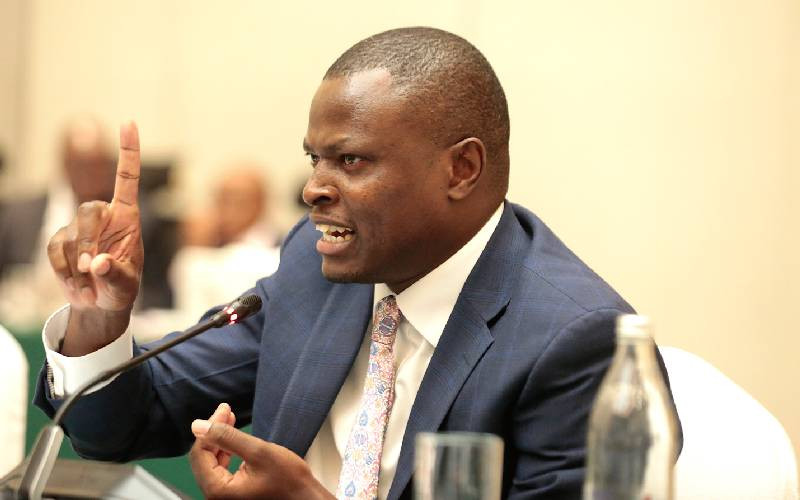
Among the absentees was Ndindi Nyoro, the Kiharu MP who had positioned himself as one of the most vocal critics of government borrowing.
He had spent weeks warning Kenyans about the national debt, speaking with the authority of someone who had studied every clause of the Bill.
He had told the House that the government wanted to “break the record of borrowing.”
He had compared President Ruto’s borrowing in a single year to a decade of Mwai Kibaki’s tenure.
When the moment came to back those words with a vote, Nyoro was not in the chamber.
His explanation came later, only after journalists pressed him. He had travelled out of the country on Wednesday evening. There was no emergency, no unavoidable circumstance. Just travel.This is not a story about bad luck.
It is a story about choice.
The Finance Bill vote was not a surprise. Every MP knew the date weeks in advance. The Bill had been the subject of public participation, committee hearings, and weeks of parliamentary debate.
Nyoro himself had spoken about it extensively. A man this immersed in the Bill’s details did not stumble into ignorance of its voting schedule.
He left, and he left knowing exactly what he was leaving behind.
What makes this harder to accept is that this is not an isolated incident. In October 2024, when Parliament voted to impeach then Deputy President Rigathi Gachagua, Nyoro was again missing from the chamber.
He was one of only eighteen MPs who skipped that vote. At the time, he offered no explanation.
It took more than a year for him to admit on television that his absence had been deliberate. He had decided, on his own, not to participate.So the question becomes unavoidable.
A man who skips an impeachment vote by design, who admits it was a calculated decision, and who then skips the most consequential tax vote of the year by “coincidence” is not unlucky.
He is consistent. And that consistency raises serious questions about the gap between public rhetoric and parliamentary action.
But Nyoro is not alone in this. Of the 349 members of the National Assembly, only 162 turned up to vote on Thursday.
That means 187 lawmakers were not in the chamber when one of the most important pieces of legislation of the year was decided.
Only 46 percent of Parliament participated in deciding how every working Kenyan will be taxed for the year ahead.
This is not a quorum failure on a minor procedural motion. This is mass desertion on a vote that determines the cost of living.
The arithmetic explains the politics. The broad-based government arrangement has folded a significant wing of the opposition into the ruling coalition, giving Kenya Kwanza a comfortable buffer regardless of who shows up.
MPs on both sides appear to have calculated that their individual vote would not change the outcome. They chose the path of least exposure: be loud in the buildup, invisible at the reckoning.
The Finance Bill 2026 is not an abstract ideological fight. It reinstates the residential rental income tax rate to 10 percent of gross receipts, up from 7.5 percent.
It extends VAT to digital financial services, including payment gateways and money transfer platforms that ordinary Kenyans use every day. It gives the Kenya Revenue Authority expanded powers to monitor digital and financial transactions.
It applies capital gains tax to offshore share transfers tied to Kenyan assets. It compresses the tax filing deadline from six months to four.These are not abstractions for a future debate. They land on payslips, rent receipts, mobile money transfers, and tax returns starting in days.
Every one of those 187 absent MPs deserves scrutiny. An MP who skips the vote does not stay above the fray. He hands his constituents’ voice to whoever bothered to show up.
The 187 did not abstain. They disappeared. And in disappearing, they let 122 votes pass for a House of 349.For Nyoro specifically, the issue cuts deeper.
He has built his entire public persona on being brave enough to ask the government uncomfortable questions. He produces a steady stream of floor speeches and social media posts.
He postures as the one Mount Kenya MP still willing to challenge the administration in public. Kenyans, exhausted and squeezed by a cost of living crisis, want to believe someone in that chamber is fighting for them.
But reputation built on visibility and reputation built on votes cast are two entirely different things. A real vote costs something.
It can cost you a seat at the political table. It can cost you standing with a government you may still need favours from. Nyoro chose to protect the relationship rather than cash the political capital his rhetoric had been building for months.
His statement after the fact, issued in soft language about peace and humility, spends paragraph after paragraph explaining why his absence does not reflect his commitment. But it never answers the only question that matters: did you know the vote was happening when you booked that trip?
That silence is the tell.
This is what makes the desertion so difficult to accept. The Finance Bill is not a distant policy document. It shapes the cost of living. It determines how much working Kenyans will pay in taxes.











Add Comment