








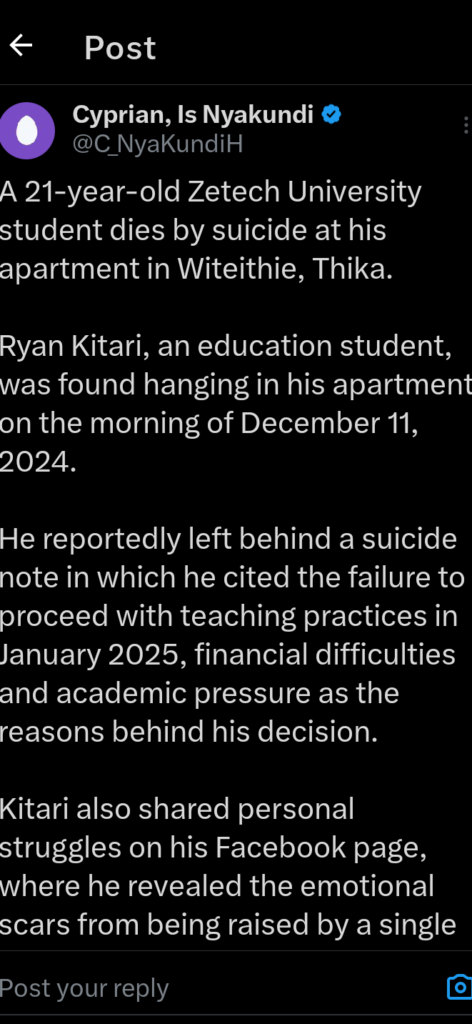
Kitari, who was found hanging in his apartment in Witeithie, Thika, on December 11, 2024, reportedly left a suicide note revealing profound struggles.
Among the reasons cited were his inability to proceed with teaching practices scheduled for January 2025, financial challenges, and the immense academic pressure he faced.
This incident paints a grim picture of the conditions students endure at the university and the institution’s alleged failure to provide adequate support.
The situation is even more heart-wrenching considering Kitari’s troubled past, as expressed in emotional posts on his Facebook page.
He wrote about the emotional scars of being raised by a single mother and alleged childhood molestation, indicating he had been battling mental health issues for years.
These revelations point to a young man seeking help in a world that may have been indifferent to his plight.
His tragic end raises critical questions about Zetech University’s role in addressing such challenges.
Universities are expected to foster environments that prioritize not just academic growth but also the well-being of their students.
However, Kitari’s story suggests a failure on this front.

The inability to proceed with teaching practices, as stated in his note, highlights possible shortcomings in the university’s academic coordination.
Such delays and uncertainties can cause extreme stress for students already grappling with tight schedules and limited resources.
Financial struggles are another issue plaguing many students in Kenyan institutions, but Kitari’s case underscores a larger systemic problem.
If universities like Zetech fail to acknowledge and address the financial hardships faced by their students, they risk losing young, promising lives to despair.
The institution’s policies and support systems must be scrutinized to determine whether adequate measures are in place to assist students in distress.
Moreover, the psychological toll on students appears to be overlooked. While most universities in developed countries have robust mental health programs, institutions like Zetech seem to lack this critical infrastructure.
Kitari’s death is not just a personal tragedy, it is an indictment of the university’s apparent neglect in addressing mental health challenges among its students.
Was there a counseling system in place? If so, did it function effectively to identify and support struggling students like Kitari? These are questions the university must answer.
The body of the young student was taken to Muriranjas Sub-County Hospital morgue, awaiting an autopsy, while police continue their investigations.
However, the real inquiry should go beyond the cause of death.
The focus should shift to the institutional failures that may have contributed to Kitari’s untimely demise.
This tragic incident should serve as a wake-up call for Zetech University to reflect on its policies and put in place meaningful changes to prevent similar occurrences in the future.














Add Comment