






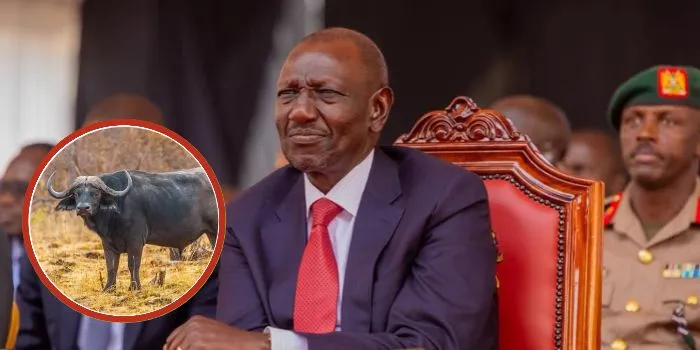

President William Ruto has directed the Ministry of Agriculture to facilitate the importation of improved camel breeds and buffaloes as his government seeks to address Kenya’s milk shortage and rising prices that have increased the cost of living for households.
Speaking at the Agriculture and Food Security Summit at Jamhuri Park in Nairobi on Friday, October 9, 2026, Ruto instructed Agriculture Principal Secretary Jonathan Mueke to proceed with plans to introduce the animals, saying Kenya needs to explore alternative sources of milk instead of depending mainly on conventional dairy cattle.
The President argued that camels and buffaloes could help increase local milk production, particularly during periods of drought when dairy farmers struggle to maintain supplies.
“I had directed the Agriculture PS to help us bring in a better breed of camel and bring another buffalo breed. Buffaloes also produce a lot of milk. In India there are buffaloes,” Ruto said.
He urged Mueke to move forward with the plan, maintaining that diversifying milk production would help the country deal with supply challenges and reduce its dependence on traditional dairy farming.
“There is no problem in that. So PS Mueke, do as we had agreed. Bring in buffalo and also bring in a better breed of camel because we need to diversify our milk sources,” he stated.
The announcement comes at a time when milk prices have risen in major urban centres, putting additional pressure on families that rely on the commodity as part of their daily diet.
A 500ml packet of fresh milk is reportedly retailing at between KSh75 and KSh80 in Nairobi, Mombasa and Kisumu, compared with the earlier range of KSh60 to KSh70.
Ruto attributed the current shortage partly to drought, which has affected milk production and disrupted supplies from dairy farmers.
“Currently, we have a slight shortage of milk due to drought. Camels have more milk than cows. We will ensure we bring in a better breed,” he said.
The President also pointed to the high price of camel milk in Nairobi, arguing that the product could create another source of income for farmers while expanding the country’s milk production options.
“Here in Nairobi, the camel’s milk is about Ksh190 and is selling at almost Ksh200, beating cow’s milk three times. We need to start thinking,” Ruto said.
However, the high price of camel milk raises questions about whether importing improved camel breeds will directly help ordinary consumers facing the rising cost of conventional packaged milk.
Camel milk and cow’s milk have different markets, processing needs and distribution systems, meaning increased camel milk production may not automatically lower the price of regular milk.
The government will therefore need to establish how the proposed imports will increase overall supply and whether the additional production will be affordable for consumers.
Data on milk deliveries to processors also points to the pressure facing the country’s dairy industry. Formal milk deliveries dropped from 84.4 million litres in June to 81.3 million litres in July 2026, with further reported declines in August and September.
The decline has coincided with rising retail prices and concerns about milk availability in some markets.
The situation has placed pressure on the dairy supply chain, which depends on farmers, cooperatives, processors and distributors to move milk from farms to consumers.Some farmers have reportedly turned to selling raw milk directly to consumers in their neighbourhoods and to brokers instead of supplying formal cooperatives.
While direct sales provide another way for farmers to reach buyers, the shift can affect the volumes collected through established dairy processing systems.
Camels are already widely valued by pastoral communities in Kenya’s arid and semi-arid areas because they can withstand dry conditions that make it difficult to keep conventional dairy cattle. Their ability to survive with limited water and pasture makes them an option for livestock production in drought-prone regions.Buffaloes are also used for commercial milk production in countries such as India.
However, introducing new breeds into Kenya would require suitable breeding programmes, veterinary services, proper feeding, water supplies and reliable systems for collecting and processing their milk.
The government has not announced the number of camels and buffaloes it intends to import, the estimated cost of the programme or when the first animals are expected to arrive. It also remains unclear how soon the proposed imports would translate into increased milk deliveries.
These details will be important in determining whether the plan can provide meaningful support to farmers and consumers.
Importing livestock requires investment, and the animals must adapt to local conditions before they can contribute significantly to commercial production.Beyond the proposed imports, Kenya’s dairy sector continues to face challenges linked to drought, animal feed costs, water availability and the productivity of existing livestock. Addressing these issues will be important in maintaining milk production even as weather conditions change.
Ruto’s proposal signals an effort to widen Kenya’s sources of milk, but its impact will depend on how quickly the plan is implemented and whether it delivers additional supplies at affordable prices.
For households already paying more for milk, the immediate concern is whether the government’s strategy will help ease the shortage and bring down retail prices.
While improved camel breeds and buffaloes could offer another route to increasing production, consumers will ultimately judge the plan by its ability to improve availability and reduce the cost of milk.












Add Comment