







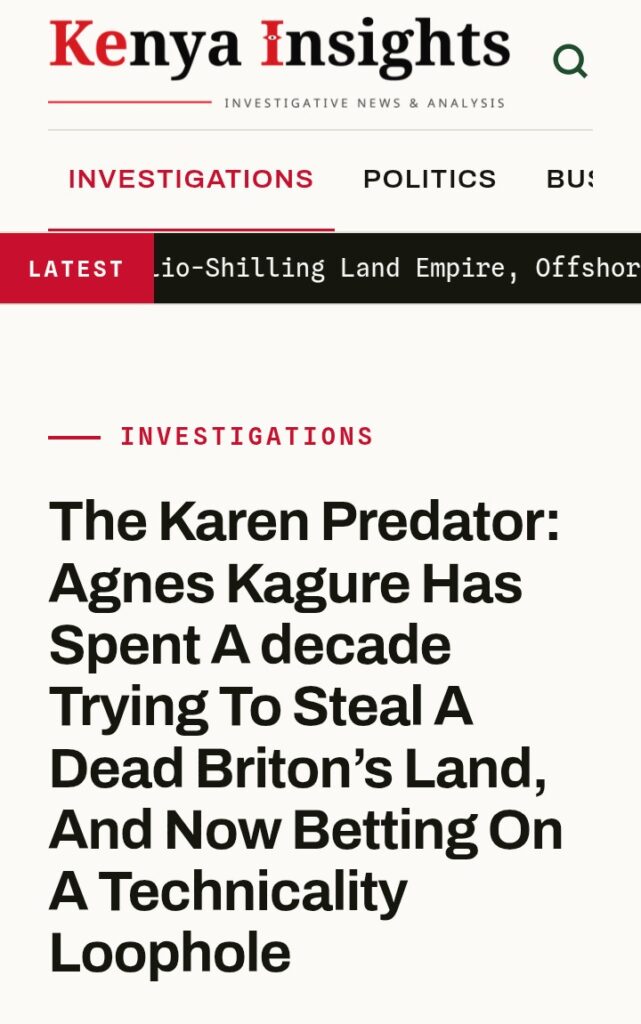
Agnes Kagure’s prolonged battle over a disputed multi-acre estate in Karen has placed her land dealings under renewed scrutiny, with court decisions challenging her ownership claims and documenting a bitter confrontation involving the property, its legally appointed executor and people who had been living on the land.
The Nairobi businesswoman and political aspirant has spent more than a decade fighting legal battles over properties in different parts of the city.
However, the dispute surrounding the former estate of British national Roger Bryan Robson on Ushirika Road has become one of the most contentious chapters in her property dealings.
The case raises serious questions about how far an individual can go in asserting control over disputed property, particularly when courts have already issued orders restricting occupation and dealings with the land.
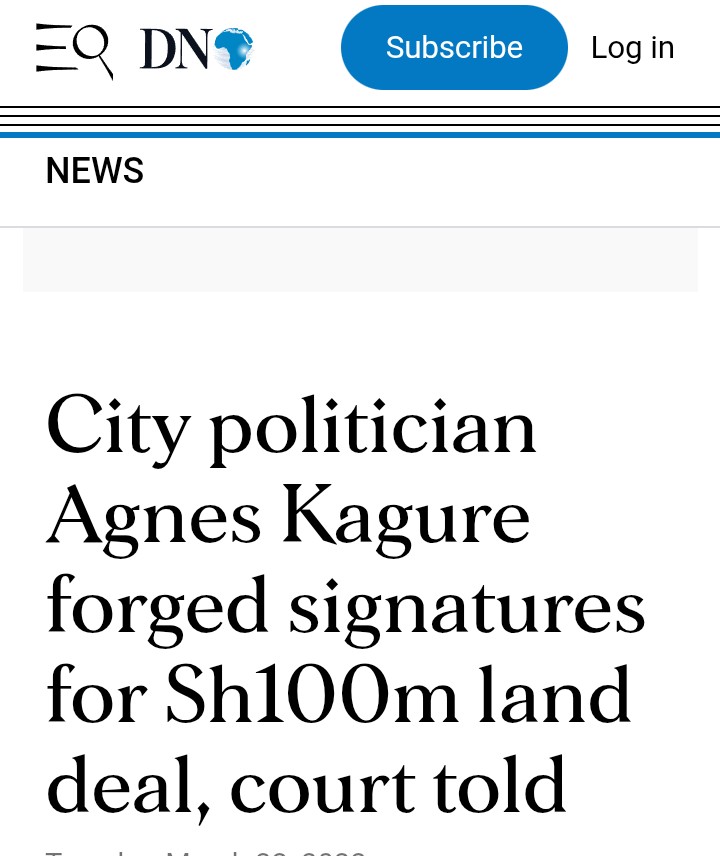
At the centre of the controversy is Kagure’s claim that she purchased Robson’s multi-acre property for approximately Sh100 million in cash in November 2011.
But that claim has faced major legal setbacks.
Robson, who died in August 2012 without children, had left a 1997 will directing that his property bordering Ngong Forest be sold, with the proceeds distributed to his nephew and conservation and educational causes.
His family disputed Kagure’s account of the alleged purchase, with Robson’s brother testifying from the United Kingdom that the property had never been sold to her.
The matter eventually landed before the High Court, where Justice Hillary Chemitei delivered a significant ruling in June 2025, finding that Robson’s will was valid and properly executed.
The court found no credible evidence establishing that Robson had sold the property to Kagure.
The ruling also found no proof that the deceased had been coerced or lacked the capacity to make his will.
The absence of credible documentation supporting the claimed Sh100 million cash transaction became a major weakness in Kagure’s position.
There was no convincing trail of bank transfers, stamp duty records or other ordinary documentation that would establish the alleged transaction.
For a property purchase involving such a substantial amount of money, the absence of a credible payment trail raises fundamental questions about the transaction.
Yet the dispute was not limited to competing claims over documents.
It developed into a physical confrontation over who controlled the estate.

Defying court orders and taking control of the Karen property
Earlier court proceedings had resulted in injunctions restricting Kagure’s dealings with the property.
An order issued by Justice Mary Gitumbi in 2015 barred the activities that could interfere with the estate while the ownership dispute remained before the courts.
However, court filings and accounts of the proceedings describe how men linked to Kagure arrived at the property accompanied by police officers, removed caretakers and proceeded with activities that included constructing a perimeter wall.
The wall was eventually built despite the earlier court restrictions.
The estate’s executor, lawyer Guy Spencer Elms, subsequently faced difficulties accessing property he was legally responsible for protecting.
When he attempted to enter the estate, he encountered a fenced property occupied by individuals who prevented him from gaining access.
The developments raised serious concerns about the effectiveness of court orders and the role of law enforcement officers in a private property dispute.In subsequent proceedings, Justice Lucy Njuguna observed that police officers had actively assisted individuals alleged to have been involved in the occupation.
That observation is particularly significant because police officers are expected to uphold the law, not become instruments in disputes involving contested property rights.
The confrontation left the executor fighting to protect an estate whose ownership arrangements had already become the subject of prolonged litigation.
It also raises a difficult question for anyone seeking public leadership: what does respect for the rule of law mean when court decisions stand in the way of personal interests?
Eastlands land disputes add to Kagure’s legal baggage
The Karen controversy is not the only property dispute that has placed Kagure’s name before the courts.
Her history of land litigation also includes disputes involving properties in Eastlands, where Environment and Land Court judges issued permanent orders preventing her from pursuing claims over particular plots.
In one case, the dispute involved land valued at more than Sh20 million, which an earlier allottee maintained he had acquired years before the competing claim emerged.
In another, a widow challenged a transfer involving property along Jogoo Road that had been registered following her husband’s death.
The courts found serious legal problems with the documents and processes supporting the disputed registrations, with judges describing the relevant transactions as illegal, unlawful or void.
These decisions are important because they go beyond ordinary disagreements between people claiming ownership of the same property.
They concern the legality of the documentation and processes through which ownership was allegedly established.
For property owners and investors, such findings raise concerns about the security of land transactions and the protection available to people whose ownership rights are challenged through questionable documentation.
The Eastlands cases also provide the background against which critics have questioned Kagure’s approach to property disputes.
The description of an Eastlands mentality being carried into Karen is a criticism of the perceived approach to property and neighbourhood relations.
Karen neighbours and questions about control of public spaces
The controversy has also generated questions about the relationship between the disputed estate and the surrounding Karen neighbourhood.
Karen is known for its residential character, large properties and comparatively low-density development.
Disputes involving boundaries, access and construction can therefore have consequences beyond the immediate property owners.
The accusations circulating around Kagure include claims that she has interfered with public access routes, dumped garbage in neighbouring spaces, attempted to dictate what neighbouring property owners can do and objected to developments undertaken around her.
There are also claims that neighbours have faced pressure to seek her approval before undertaking construction or making changes to their own properties.
That record provides sufficient grounds for serious questions about the conduct surrounding the disputed property.
No individual, regardless of wealth, political connections or business influence, has the authority to exercise control over public roads or dictate how other lawful property owners use their land.
Threats of connections and the politics of influence
Another concern raised in accounts of the neighbourhood tensions involves claims that Kagure invokes her connections when dealing with people who disagree with her.
The allegations describe a situation in which neighbours feel pressured by the prospect of political or influential connections being used against them.
The use of state officers in private land disputes undermines public confidence in institutions that are supposed to protect everyone equally.
A person with financial resources or influential relationships should not enjoy a different standard of treatment from an ordinary Kenyan struggling to protect a legally acquired property.
The Sh140 million investment dispute adds another controversy
Kagure’s legal and reputational challenges extend beyond property ownership.
German investor Uwe Heinz Odenthal has accused her of involvement in a failed petroleum investment through Trojan Six Oil 2019 Ltd, claiming that more than Sh140 million was invested after promises of substantial annual returns.
Odenthal claims that he subsequently encountered difficulties obtaining responses from the company’s directors.
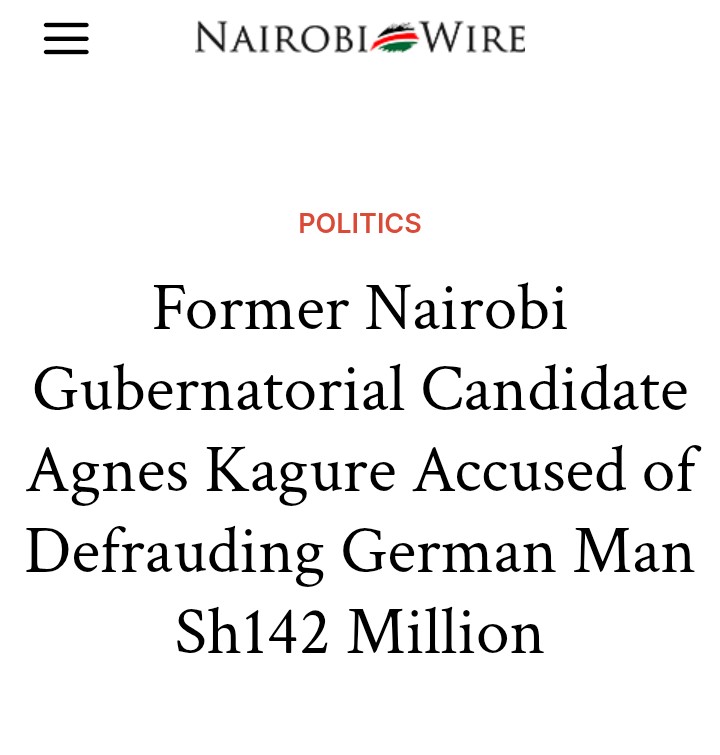
Kagure has rejected the accusations, describing them as blatantly false, and has demanded that media organisations retract reports relating to the dispute while threatening legal action.
Nevertheless, the dispute has added another layer to the controversies surrounding her business dealings.
Political ambitions cannot erase the court record
Kagure’s political journey has also been affected by controversies surrounding her professional and business background.In 2018, when former Nairobi Governor Mike Sonko considered her for the position of deputy governor, questions surrounding her academic qualifications and emerging land disputes became part of the debate surrounding her possible nomination.
She subsequently contested the Nairobi gubernatorial seat in 2022 but finished far behind the leading candidates.
Her political ambitions have continued under the Kenya Patriots Party, even as the legal disputes surrounding her property dealings remain part of the public conversation.
By late 2026, she had shifted her attention towards the Nyeri gubernatorial race, where she began erecting campaign billboards and engaging local political leaders.
But changing political battlegrounds does not automatically remove questions raised by years of litigation.
The Karen estate dispute remains particularly damaging because it involves a deceased foreign property owner, a disputed cash purchase, a contested will, court injunctions and a prolonged fight over physical possession.
Justice Chemitei’s June 2025 decision also placed a significant obstacle in the way of Kagure’s ownership claim by upholding Robson’s will and finding no credible evidence supporting the alleged sale.
The subsequent history of the property, including the construction of the perimeter wall and the reported involvement of police officers, makes the matter even more serious.
The questions Kagure cannot escape
Kagure is entitled to defend herself against accusations and pursue legitimate property claims through the courts.
However, those rights come with an obligation to respect judicial decisions and the property rights of others.
The questions surrounding the Karen estate are not minor disagreements between neighbours. They concern a property whose ownership was contested in court, an executor appointed to protect the deceased’s estate, injunctions restricting interference and a purchase claim that failed to withstand judicial examination.
The Eastlands cases add further weight to questions about the documentation and processes used in other property claims associated with her.
Meanwhile, the separate Sh140 million petroleum investment dispute remains another unresolved controversy that she has publicly contested.
For the Robson estate, the battle has dragged on since the deceased’s death in 2012, leaving the executor and intended beneficiaries dealing with years of legal proceedings.
The wider public interest lies in ensuring that court orders are respected, public institutions remain independent and property disputes are resolved through lawful processes rather than physical occupation or the influence of powerful individuals.
As Kagure seeks to expand her political influence beyond Nairobi, the record of these disputes deserves public examination.
A political aspirant seeking the trust of voters must be prepared to answer legitimate questions about her dealings, her respect for court orders and her approach to other people’s property rights.
No amount of political ambition, business success or influential connections should place anyone above the law.














Add Comment