






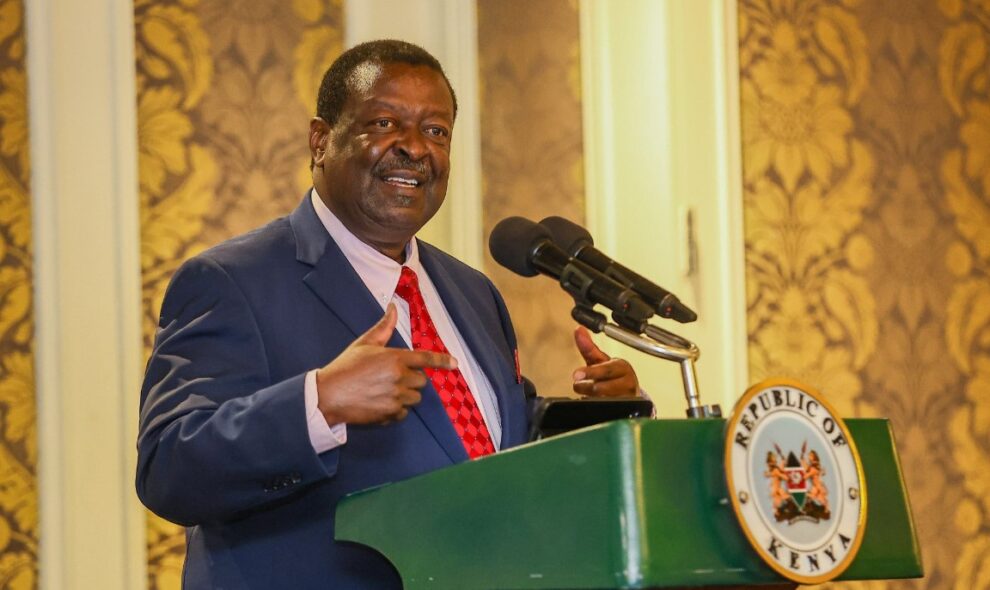

Prime Cabinet Secretary Musalia Mudavadi is facing renewed scrutiny over his private business interests following reports that an investment company linked to him has agreed to pay approximately Sh3 billion to acquire controlling stakes in two insurance firms from South Africa’s Absa Group.
The transaction has raised questions about the source of the acquisition funds and the timing of the deal, particularly because a related investment company has been at the centre of a Sh363.4 million dispute involving NCBA Bank, KCB Bank and Co-operative Bank.
The matter has also drawn the Office of the Director of Public Prosecutions (DPP) into a confrontation that has seen senior banking executives face criminal proceedings.
According to a Business Daily report published on October 18, 2026, First Assurance Investments Limited has agreed to acquire Absa Group’s 63.32 per cent shareholding in First Assurance Company Limited and Absa Life Assurance Kenya Limited.
The deal would return control of the two insurance businesses to local investors associated with their previous ownership. However, the reported purchase price has placed the investment company under fresh scrutiny over how it intends to finance such a substantial acquisition.
The financing arrangements have not been publicly disclosed, while the transaction remains subject to regulatory approvals.
The questions are significant given Mudavadi’s position in government and his declared net worth of approximately Sh4.1 billion during his parliamentary vetting in 2022.
His declared wealth included interests in insurance, property and other private companies.
However, a personal wealth declaration does not, by itself, establish how a company intends to raise Sh3 billion for an acquisition. The funds could come from shareholder contributions, existing investments, commercial loans or a combination of financing arrangements.
The investors therefore face questions over the proposed funding structure, the institutions involved in financing the purchase and the assets that may be used as security.
These questions have gained further attention because of the separate Sh363.4 million dispute involving the investment company and the three banks.
The dispute centres on allegations that former nominated MCA Salim Mohamed Busaidy unlawfully withdrew company funds between May 2018 and April 2024 through cheques allegedly bearing forged signatures.
Prosecutors accused Busaidy of abusing his position as a company director to access funds held in accounts at NCBA, KCB and Co-operative Bank.
He denied the charges.The case subsequently developed into a wider confrontation over the banks’ handling of the disputed transactions and whether they had met their legal obligations concerning suspicious financial activity.
Representatives of the company reportedly sought repayment of the disputed funds from the banks.
The institutions did not agree to the proposed repayments, and the dispute escalated when the DPP moved to prosecute senior banking executives over alleged failures to report suspicious transactions.
The prosecutions raised questions about the legal responsibilities of the banks and the basis for holding individual executives criminally responsible for the alleged reporting failures.
The affected executives challenged the proceedings in court and obtained interim High Court orders in August halting the prosecutions against them.
The developments have placed the DPP’s handling of the dispute under scrutiny, particularly over the evidence supporting the charges and the relationship between the criminal proceedings and the demands for repayment.
Mudavadi’s reported links to the investment company have also made transparency an important issue.
His position as Prime Cabinet Secretary means that any questions concerning possible interactions between his business interests and state institutions are likely to attract public attention.
There is, however, no evidence in the information provided establishing that Mudavadi interfered with the investigations or directed prosecutors to pursue the bank executives.
He faces questions over whether he or his representatives contacted investigators or prosecution officials regarding the dispute, and whether any such communications influenced the handling of the case.
The DPP, meanwhile, faces questions over the evidence used to pursue the banking executives and the safeguards in place to ensure that criminal prosecutions are not influenced by commercial pressure or political connections.
The central issue is whether the insurance acquisition and the banking dispute can be independently accounted for, with clear financing arrangements and transparent legal processes.
Until the acquisition’s funding structure is disclosed and the outstanding questions surrounding the bank dispute are adequately addressed, the two matters are likely to remain under public scrutiny.














Add Comment