






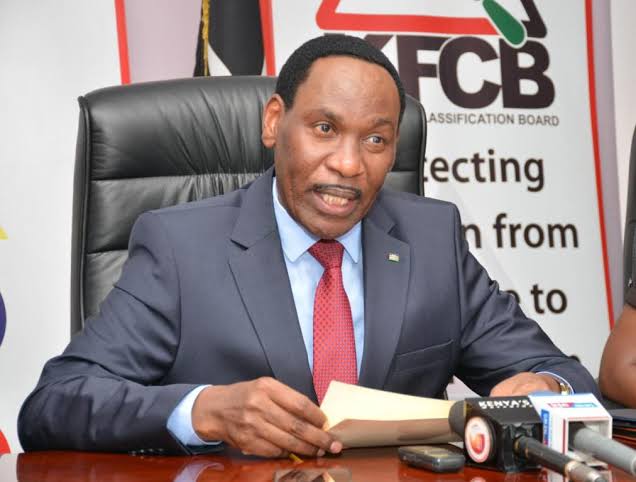

Ezekiel Mutua, the former CEO of the Kenya Film Classification Board (KFCB), has been exposed for pocketing millions of taxpayers’ money through an illegal salary increment.
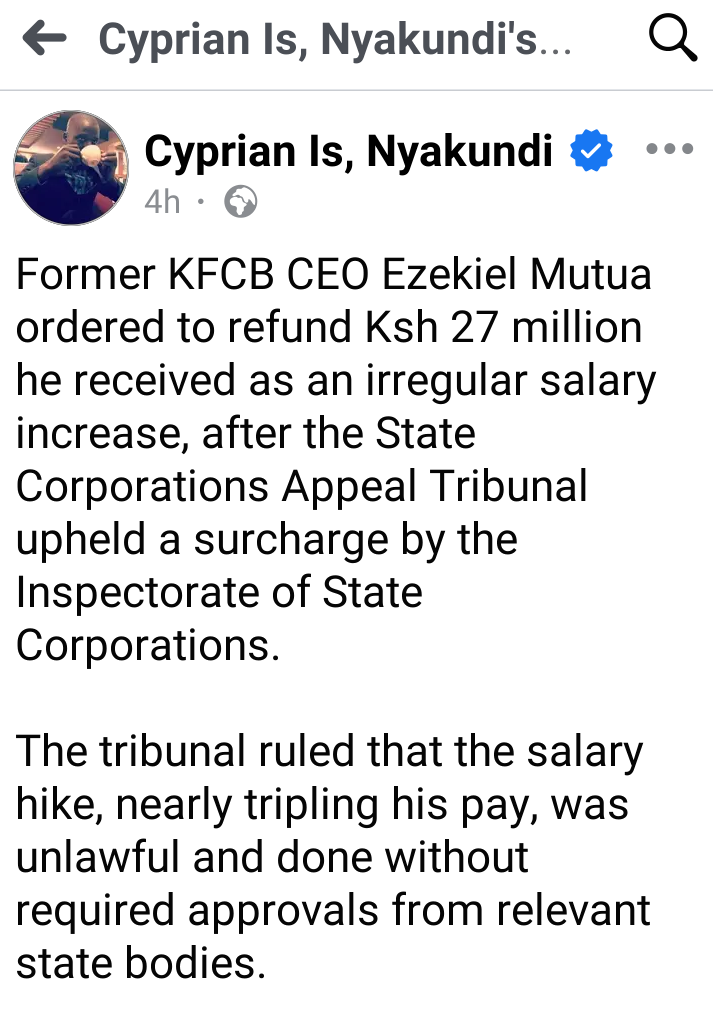
A tribunal has now ordered him to pay back Ksh.27 million, money he received after his pay was hiked from Ksh.348,840 to a shocking Ksh.1.1 million during his second term in office.
This wasn’t a small error or an overlooked detail this was a clear abuse of power backed by a board that operated outside the law and rewarded one of its own without proper approval.
The State Corporations Appeal Tribunal made it clear that the raise Mutua received was not only irregular but also unlawful. According to findings from the Inspectorate of State Corporations, Mutua’s second term itself was a problem.
His contract was renewed in 2018 even though the Sports Cabinet Secretary had declined to do so. Despite this rejection, the board went ahead to not only give him another term but also gifted him a massive salary hike that was not approved by the Salaries and Remuneration Commission (SRC), which is the only legal body allowed to determine such increases in the public sector.
Worse still, the inspectorate noted that this illegal increment was given on what was described as a “personal to self” basis, meaning Mutua directly benefited from a decision in which he was personally involved.
It’s a textbook case of conflict of interest, where a public official sat in on decisions that financially benefited him, then claimed he was simply following orders from the same board he was part of.
This is the kind of manipulation that continues to harm public trust in state corporations.
Despite warnings from the Cabinet Secretary to recover the money, the KFCB board failed to act, pushing the matter all the way to the tribunal.
Mutua, in his defence, tried to distance himself from the wrongdoing. He said he believed everything was in order because he continued to serve without any objections from the ministry.
But ignorance is not an excuse, especially when public funds are involved. His argument that he assumed the salary was legitimate because no one questioned it is weak and unacceptable. A public servant of his rank should know better than to accept such a suspicious raise without checking if it was approved through the proper legal channels.
The Tribunal’s ruling also placed blame on Nehemiah Koech, a KFCB board member who supported the illegal pay rise. It’s now clear that this wasn’t an accident it was a coordinated move by those within the board to bypass the law and reward themselves.
Mutua and Koech must both bear full responsibility for manipulating a system meant to serve the public.
This case is not just about one man’s greed. It represents a broader issue in state agencies where boards feel untouchable, make rogue decisions, and walk away with millions while ordinary Kenyans suffer.
Mutua once presented himself as a moral crusader while heading KFCB, constantly lecturing Kenyans on ethics and values. Yet behind closed doors, he was part of a board that quietly handed him triple the legal salary with no shame.
This kind of hypocrisy must be confronted head-on, and the ruling to recover the money is a step in the right direction. But accountability must go further. Investigations into whether criminal charges should follow must be considered.
Public funds were stolen, and the people responsible must face real consequences.










Add Comment