
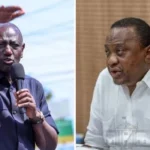


President William Ruto has defended his administration against criticism over Kenya’s corruption record, pointing to projects undertaken by previous governments and specifically questioning the role of retired President Uhuru Kenyatta in the construction of the Standard Gauge Railway (SGR).
Speaking during a church service at St. Mary’s Church in Narok County on Sunday, November 15, Ruto dismissed attempts to associate him with the challenges highlighted in a World Bank report that ranked Kenya among countries facing serious corruption concerns.
The Head of State argued that the SGR project, which has featured prominently in discussions surrounding public spending and corruption, was undertaken before he assumed office.
He suggested that critics attempting to link him to the project should also explain their own interests in the matter.
“The report also points to challenges surrounding the SGR in the past. Those attempting to blame me should understand that I was not the one who constructed the SGR. There are many things being said, and perhaps some of those making the accusations have interests linked to the money from the SGR,” he said.
Ruto’s remarks appeared to shift attention towards decisions made under previous administrations, with the retired President Uhuru Kenyatta’s government having overseen the construction of the railway project.
The president also defended his administration’s position on the publication of the World Bank report, saying his government had supported making the findings public to give Kenyans an opportunity to understand the country’s economic situation.
According to Ruto, the report covered several issues affecting the country, but some of his political opponents were concentrating on selected sections to advance their criticism of his leadership.
“I want to make it clear that my government called for an open report so that Kenyans could understand what is happening. The report contains several issues, but some people are picking out just one page and drawing conclusions from it,” he noted.
Away from the corruption debate, Ruto addressed the clashes that occurred between supporters of two local political leaders during a Maasai cultural celebration at the Maasai Mara in Narok County.
He called on politicians to avoid allowing their political disagreements to spill over into confrontations involving ordinary citizens, insisting that leadership positions should be determined through elections rather than political intimidation or violence.
The president specifically referred to Patrick and Gabriel, noting that both leaders belonged to the United Democratic Alliance (UDA), and urged their supporters to respect the democratic process.
“I want to urge our brothers and sisters not to turn political differences into confrontations among citizens. Patrick and Gabriel are both members of UDA. The governor’s seat cannot be decided by one person. Every seat will be decided by the voters. The same applies to the presidency,” Ruto said.
Defence Cabinet Secretary Soipan Tuya also condemned attempts by political leaders to divide communities along ethnic lines, calling for responsible leadership and peaceful political engagement.
Tuya said leaders had a responsibility to speak out whenever citizens were being encouraged to take political positions that could create divisions within communities.
“When we see citizens being led in the wrong direction, we must speak the truth. One way of doing this is to make it clear that we will not accept leaders who promote division along ethnic lines,” she said.
Other leaders who accompanied Ruto during the Narok visit also expressed support for his administration, urging Kenyans to back his leadership.
They pointed to development projects undertaken in different parts of the country, arguing that the government’s record should be considered as Kenyans assess his leadership and possible second-term bid.


Add Comment