








The recent controversy surrounding the EABL-Asahi deal has exposed a deeply troubling situation in Kenya’s judicial system, raising serious questions about the integrity of some judges and the vulnerability of the country’s legal processes to manipulation.
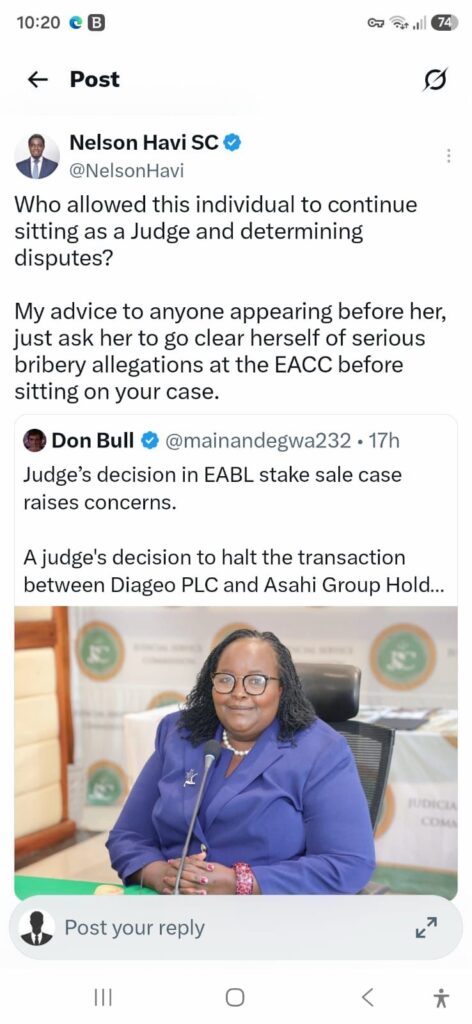
Former Law Society of Kenya President, Nelson Havi, has once again placed himself at the center of the storm, this time focusing his attention on Lady Justice Josephine Mong’are, accusing her of corrupt conduct and abuse of office.
The case involves a significant corporate transaction where Diageo PLC, a UK-based company, planned to sell its controlling stake in East African Breweries PLC (EABL) to Japan’s Asahi Group Holdings.
This deal, valued at approximately Sh300 billion, was being heard in the High Court in Nairobi, where multiple judges had already declined to stop the transaction.
However, in what appeared to be a classic case of forum shopping, a new petition was filed in Machakos, where Justice Mong’are issued conservatory orders halting the entire deal.
Nelson Havi has been the most vocal critic of this situation, and he has not minced his words. Havi has publicly questioned why Justice Mong’are is allowed to continue sitting as a judge while facing serious bribery allegations, and he has advised parties appearing before her to ask her to clear her name at the Ethics and Anti-Corruption Commission (EACC) first.
His concerns are not isolated. He has lodged formal complaints against the judge with the Judicial Service Commission, citing gross misconduct and incompetence.
Havi has even gone a step further, calling for the formation of a tribunal to remove her from office . This is not a personal vendetta. Havi’s campaign is underpinned by specific and grave allegations.
The heart of the allegations is that the Machakos injunction was not about justice but about creating an opportunity for extortion.
Havi and other senior legal figures, like Ahmednasir Abdullahi, have pointed to the suspicious timing of the injunction, which was issued hours after the Nairobi court declined similar orders.
This sequence of events leads to the strong suspicion that litigants are shopping for a judge they believe can be influenced.
Ahmednasir’s comments were stark, suggesting that the endless litigation is a trap for bribery, where the real goal is to force multinational companies to “do the needful” and pay bribes for the deal to move forward.
Justice Mong’are herself is not just facing allegations in the media. Reports indicate that a former judge, Joseph Mutava, was allegedly sent to seek a Ksh 10 million bribe from a litigant in a property dispute, with the money reportedly intended for her.
In another matter, Havi claims an agent collected Ksh 5 million on her behalf, and when the full amount was not delivered, unfavorable rulings were issued against his clients.
It is also reported that Justice Mong’are recently obtained orders from the High Court to stop the EACC from investigating her over a Ksh 1.9 billion loan dispute involving former Cabinet Secretary Raphael Tuju.
Her move to block the anti-corruption watchdog from investigating her, rather than cooperating, further damages her credibility.
This situation has severe implications for Kenya. The EABL-Asahi deal is a massive investment that promised significant capital gains tax and a vote of confidence in Kenya’s economy.
However, this judicial controversy sends a damaging signal to local and international investors that the country’s legal system is unpredictable and can be held hostage by corrupt interests.
When judges are accused of corruption and the public perceives that the courts are for sale, the rule of law itself is undermined.
This is not about one judge or one case. It’s about the integrity of the entire judiciary.














Add Comment