







Kenya now faces fresh economic uncertainty following a new policy announcement from the United States that could affect countries with active trade links to Iran.
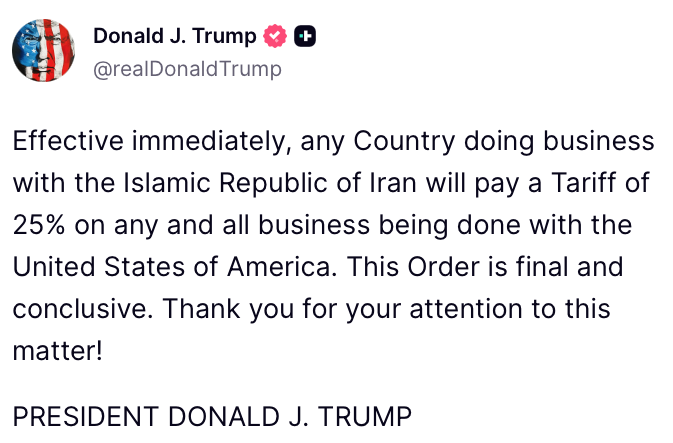
The decision, made by U.S. President Donald Trump, introduces a 25 per cent tariff on any country that continues doing business with Iran while also trading with the United States.
This move places Kenya in a difficult position due to its long-standing trade relationship with Tehran, especially in the tea sector.
President Trump made the announcement on Monday, January 12, stating that the tariff would take effect immediately. He said any country conducting business with Iran would be subjected to a 25 per cent tariff on all business done with the U.S.
The directive was issued following Iran’s violent response to recent anti-government protests, which the U.S. administration described as dangerous and unacceptable. Trump emphasized that the order was final and would not be reconsidered.
Although Iran’s biggest trading partners are China, Turkey, the United Arab Emirates, and Iraq, Kenya has also maintained steady trade ties with the Middle Eastern country over the years.
Kenya’s main export to Iran has been tea, a key foreign exchange earner for the country. The trade relationship has grown steadily, with Iranian imports of Kenyan tea increasing significantly. In 2020, Iran imported about 3.2 million tons of Kenyan tea. By 2024, that figure had risen to approximately 13 million tons, showing how important the Iranian market has become for Kenyan tea farmers and exporters.
Despite this growth, the trade relationship has not been smooth. Towards the end of 2024 and into early 2025, Kenyan tea exports to Iran were disrupted after Iranian authorities raised concerns over quality standards. These concerns led to a temporary ban on Kenyan tea imports, causing anxiety among exporters and farmers who rely heavily on external markets.
Efforts were later made to repair the relationship. In August last year, Kenya and Iran held fresh talks aimed at strengthening economic cooperation.
These discussions took place during the 7th Joint Commission for Cooperation meeting held in Nairobi. The talks were led by Prime Cabinet Secretary Musalia Mudavadi and focused mainly on resolving the tea trade issues while also exploring ways to expand cooperation in other sectors.
Alongside the meeting, a Kenya–Iran business forum was organized to connect business people and investors from both countries. Iranian firms were encouraged to view Kenya as a gateway to the wider East African market.
Both governments expressed interest in deeper cooperation in areas such as agriculture, manufacturing, ICT, creative industries, food processing, renewable energy, and pharmaceuticals.
However, the new U.S. directive now casts doubt over these plans.
Kenya risks facing the 25 per cent tariff if it continues trading with Iran while maintaining access to the U.S. market.
Such a tariff could make Kenyan exports to the U.S. more expensive and less competitive, adding pressure to an economy already dealing with multiple challenges.The situation is made more tense by reports that the U.S. government is considering possible military action against Iran over the ongoing protests.
Kenya may be forced to make difficult decisions about its trade priorities, balancing economic interests against the risk of penalties from one of its key international partners.














Add Comment