








Public servants working under Kenya’s national government are entering 2026 with improved pay after a new salary structure was approved and set to take effect retroactively.
The changes follow a decision by the Salaries and Remuneration Commission to adjust salaries and allowances under the first phase of the 2025–2029 remuneration and benefits review cycle.
The approval was communicated through a circular shared by Central Organisation of Trade Unions Secretary General Francis Atwoli. The circular explains that the SRC held a meeting on December 19, 2025, where it discussed and approved changes to basic salaries and leave allowances for civil servants across all grades in the national government.
This means many workers are now entitled to backdated payments starting from July 1, 2025.
Part of the communication was addressed to Public Service Principal Secretary Jane Imbunya and referenced earlier correspondence that guided negotiations during the review process.
The circular stated, “Reference is made to your letters Ref. No. MPS&HCD.12 dated September 2, 2025, on the guidelines for negotiations on the 4 remuneration and benefits review cycle 2025-2029 and Ref. No. MPSP&DM/9/1 dated December 11, 2025, on the above subject.” It further confirmed, “The approved Basic Salary structure and Leave Allowance should be implemented with effect from July 1, 2025, at a cost of Ksh 2,065,701,510 for the Financial Year 2025/2026.”
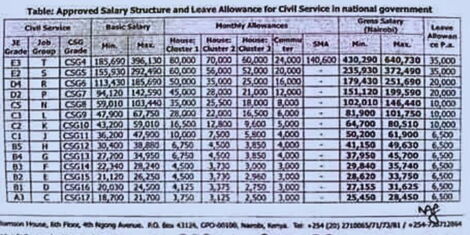
The revised salary structure affects civil servants in grades CSG1 to CSG17, as well as other designated job groups.
Allowances under the new framework are calculated based on job classification and location. One of the notable changes is the introduction of a Salary Market Adjustment, which brings together several allowances that were previously paid separately.
These include entertainment, domestic servant, and extraneous allowances, now combined into one simplified adjustment to make administration easier.House allowances have also been reviewed and grouped into three clusters.
Nairobi is placed in Cluster 1, reflecting its higher cost of living. Cluster 2 includes major cities such as Mombasa, Kisumu, and Nakuru, along with municipalities like Nyeri, Eldoret, Thika, Kisii, Malindi, and Kitale. Cluster 3 covers all other parts of the country.
According to the SRC, workers in Nairobi will receive the highest house allowance rates, while those in smaller towns and rural areas will receive lower amounts in line with living costs.
Under the new pay structure, higher-grade officers such as those in CSG4 will earn a basic salary ranging from Ksh 185,690 to Ksh 396,130.
For those based in Nairobi, house allowances can go up to Ksh 140,600. On the lower end, employees in grades like CSG15 will see their basic pay rise to between Ksh 21,120 and Ksh 26,250, with house allowances of up to Ksh 4,500.
The SRC explained that the Salary Market Adjustment is meant to align public service pay with current market conditions while following constitutional and legal requirements.
The new framework also revises leave allowances, with the aim of compensating staff for accumulated leave and providing extra financial support when employees take time off.
For unionisable staff, the pay changes will be implemented through Collective Bargaining Negotiations, allowing worker representatives to take part in final discussions.
The SRC has advised all ministries, departments, and agencies to implement the new salaries and allowances without delay and to ensure that all backdated payments from July 1, 2025, are settled promptly.
This pay rise represents the first step in the fourth remuneration review cycle running from 2025 to 2029. The SRC has indicated that further reviews will follow in later phases to keep public service pay fair, competitive, and in line with the country’s economic situation.













Add Comment