






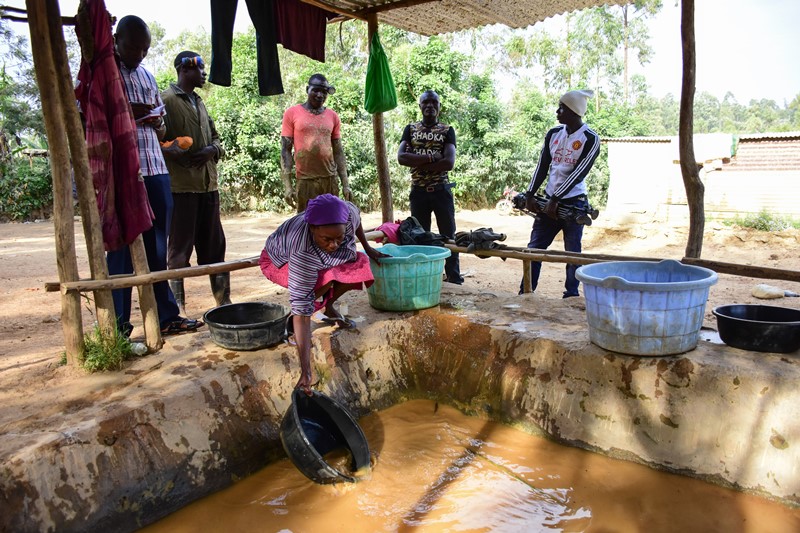

Women working around the gold mines of Abimbo in Siaya County face daily abuse driven by poverty and power imbalance. For many widows, mining is not a choice but a last option to feed their families.
What they encounter there is a system where access to work is controlled by young men and where sex is often demanded before women can earn anything.
Siaya lies within a known gold belt near Lake Victoria, an area that should support local livelihoods. Instead, informal mining has grown without rules or protection.
In Abimbo, young men control the pits and the gold-bearing stones. They dig deep and dangerous holes by hand and decide who gets stones to process.
Women are mostly left to crushing, washing, and sorting the stones. This dependence puts them at the mercy of those who control supply.
Siaya County has a high number of widows, estimated at about 50,000 out of a population of 1.1 million. Many widows lack land, jobs, or support.
When farming fails or casual work disappears, the mines become their only option. Once there, many are forced into a practice locally known as “Apinde,” where sex is exchanged for stones.
Women say refusal means total exclusion. Without stones, there is no income, and without income, there is hunger at home.
Women report that men keep the best stones and release scraps unless they are paid with money or sex. Even when women agree, the abuse does not stop. Some men demand repeated encounters, and others use intimidation or physical strength to get what they want.
Older widows say the experience is especially humiliating, with young men often demanding sex despite being the age of their children.
Abuse often happens inside the mining pits. These pits are dark, deep, and unsafe. What should be a place of work becomes a place of fear.
Women move from one site to another as pits dry up, only to face the same demands again. Local leaders rarely intervene, and police visits are uncommon.
The practice is often dismissed as normal or cultural, leaving women with no protection.
Some women try to dig on their own to escape dependence, but this exposes them to even greater danger. Pit collapses are common. In March 2023, at least five women died when a prohibited gold pit collapsed in Lumba Village, Rarieda Sub-County.
Their deaths showed how women face risk from both unsafe mining and exploitation by men.
Health risks are severe. Many men refuse protection, and women lack power to negotiate. Siaya has one of the highest HIV rates in Kenya, with prevalence far above the national average.
Widows are the most affected. Alcohol and drugs are common at mining sites, making violence and coercion worse. Health services rarely reach these areas, and many women learn their HIV status only after becoming seriously ill.
Despite the danger, most women earn very little. Middlemen buy gold cheaply and make the real profits.
Government plans to formalise artisanal mining have been slow, leaving women exposed. Without regulation, protection, and alternative livelihoods, widows remain trapped.
What happens in Abimbo reflects a wider failure to protect vulnerable women in mining areas. Gold continues to benefit a few while many women pay the price with their health, dignity, and lives.
Real change will only come with firm action to regulate mining, protect women, and hold abusers accountable.












Add Comment