






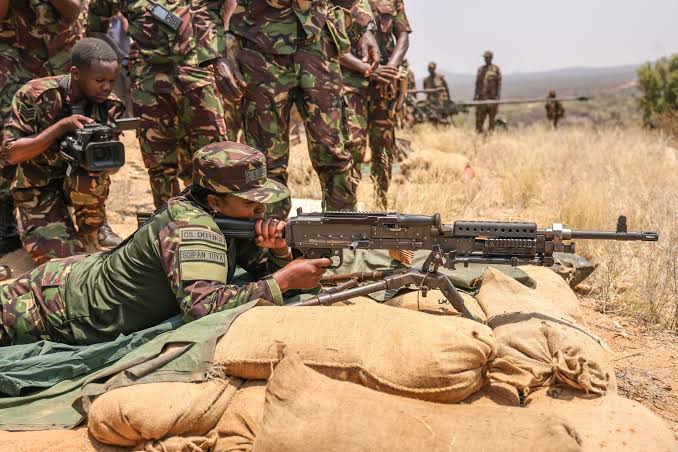

Security concerns in parts of the Rift Valley have pushed the government to rethink how it handles long-running conflict and banditry, especially in the Kerio Valley.
Rather than relying on short-term deployments that fade with time, authorities are now focusing on a more permanent presence meant to stabilise the region and build trust with local communities.
Interior Cabinet Secretary Kipchumba Murkomen announced that beginning January 2026, the government will establish new security training grounds within the Kerio Valley. These facilities will be used by both the Kenya Defence Forces and the National Police Service. The aim is to allow the two forces to train and operate from the same area, improving coordination and response to insecurity.
President William Ruto has already approved the plan, clearing the way for implementation.
Murkomen explained that the training grounds will function much like existing national facilities such as Kiganjo, but with a local focus. He said the government plans to set up permanent security installations, including operational bases for specialised units.
According to him, this approach is meant to ensure security teams are always present and familiar with the terrain and local dynamics, instead of being deployed only after violence has erupted.
The decision is closely linked to the persistent problem of banditry in the region. For years, communities in Kerio Valley and neighbouring areas have faced cattle rustling, revenge attacks, and armed raids.
While disarmament exercises and police operations have reduced violence at times, the problem often returns once security pressure eases. Murkomen said the new plan is meant to offer a lasting solution rather than repeating temporary measures that have failed in the past.
He also urged residents to continue working with security agencies, saying community cooperation has already shown positive results.
Speaking in Marakwet East on December 26, Murkomen noted that residents were able to celebrate Christmas without major security incidents, a change from previous years. He attributed this improvement to better collaboration between locals and the government.
The announcement comes shortly after Murkomen declared several parts of Trans Mara in Narok County as disturbed and dangerous areas.
In a Gazette Notice dated December 19, 2025, areas such as Kilgoris, Ang’ata Barrikoi, Lolgorian town, Mogondo, Keyian, Kirindon, Olderkesi, Nkararo, and Kapsasian were listed as insecure.
Other regions including Ntimaru, Maji Moto, Naisoya, and several surrounding areas were also named due to ongoing clashes that left people dead and many others displaced.
Despite ongoing disarmament efforts, insecurity has remained a challenge. Murkomen recently said that about 1,000 illegal firearms were recovered in the latest exercise, leading to a noticeable drop in attacks.
However, he admitted that some bandits remain bold, partly because they do not fear National Police Reservists.In response to the latest violence, Deputy Inspectors General of Police Eliud Lagat and Gilbert Masengeli announced a 30-day dusk-to-dawn curfew in Trans Mara East and South starting December 20.













Add Comment