




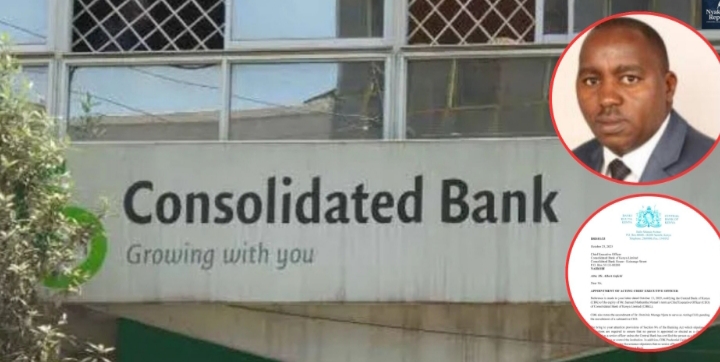

Concerns around Consolidated Bank have been growing after the government placed Dr Dominic Njeru in charge even as questions continue to surround his suitability for the role.
His appointment as acting CEO has opened a wide debate inside the banking sector, among regulators, and within political circles because it comes at a time when he is facing allegations linked to Sh19 million said to be under investigation by the Ethics and Anti-Corruption Commission.
Many stakeholders feel that placing him at the top of a government-owned bank before clearing these issues undermines basic governance standards expected in public institutions.
The process followed during his appointment has also attracted sharp criticism. The Treasury moved ahead without following standard banking procedures, something that has unsettled the Central Bank of Kenya.
The regulator argues that no one should take up a senior post in any bank without passing the mandatory fit and proper test.
Letters from the Central Bank pointed out the Banking Act and prudential guidelines that require full approval before an officer can assume a top position.
The regulator even demanded a complete submission of the necessary documents to justify Njeru’s appointment, showing that the bank should not have proceeded before meeting the legal requirements.
Another part of the controversy is the political angle tied to Njeru’s rise. His elevation is being linked to internal political decisions involving senior figures in government.
His brother, Charles Muriuki Njagagua, previously served as chairman of the bank before moving to the role of legal adviser to the President.
When he left the bank, he pushed for Njeru to take over as CEO, despite the existence of a contract binding the outgoing CEO, Sam Muturi, for three more years.
Muturi was dismissed without warning and has since gone to court accusing the Treasury of violating his rights and ignoring lawful procedures. Many within the banking sector view this as a sign that political decisions have overtaken professional governance.
Questions around Njeru’s suitability have also been fueled by ongoing investigations at the University of Nairobi, where he is accused of playing a part in mismanaging funds amounting to hundreds of millions over several years.
Even though the investigations have not been concluded, the concerns alone have created discomfort among those who expect stricter vetting for leaders of state-owned banks.
Reports have also emerged claiming that he used the bank’s car to participate in political campaigns in Mbeere North, something critics describe as a misuse of public resources.
Even as leadership concerns persist, Consolidated Bank has managed to post profits.
For the nine months ending September 2025, the bank recorded Sh80.2 million in profit, supported mainly by earnings from government securities. Interest income grew significantly after the bank increased its investments in Treasury bills and bonds.
Expenses on interest also dropped, helping to improve the overall financial position. However, this performance has not erased concerns about the internal structure of the bank.
Many senior managers, including key department heads, are serving in acting positions, and the bank currently lacks a functional board.
Only one board member, Florence Oluoch, signed the financial statements, signaling how stretched the governance framework has become.
The government, which owns most of the bank, has not addressed the delays in putting together a proper board or naming a permanent CEO.
This silence has added to the uncertainty, especially now that the bank is trying to rebuild after years of instability. The decision to push through Njeru’s appointment without full regulatory clearance shows the conflict between political influence and the need to protect public financial institutions.









Add Comment