







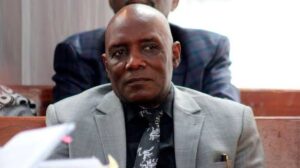
Chief Magistrate Nathan Shiundu Lutta found himself under sharp scrutiny after his conduct in a sensitive defilement case was questioned during an interview before the Judicial Service Commission, where he was seeking promotion to the High Court.
The case involved a police officer accused of defiling his own daughter, and the decisions made while the matter was in court raised serious concerns about how justice was handled and whether the safety of a child was given enough priority.
The case attracted public attention after details emerged about how the accused officer was treated by the justice system. According to accounts shared by lawyer Nelson Havi, the first step was the arrest of the policeman.
That move was welcomed as a sign that the law was taking action. However, the accused was later released on cash bail.
Instead of facing trial, he fled to Tanzania. With the help of Interpol, he was traced and returned to Kenya.
Despite this history of the accused, the court again granted him cash bail. These repeated decisions allowed the suspect to stay out of custody and weakened confidence in the seriousness of the process.
Those supporting the child tried to protect her by placing her under witness protection. Even then, the child was reportedly still reached, raising questions about how effective the protection was.

There were also claims that the accused sold land to raise money, which was used to pay legal fees and allegedly to influence people within the Office of the Director of Public Prosecutions and the court.
These claims, deepened frustration among those who followed the case and saw it as an example of how power and money can interfere with justice.
During the JSC interview, commissioners questioned Lutta closely about his rulings. Njoki Ndung’u and Jacqueline Ingutiah were among those who pressed him on how the case was handled. They focused especially on the repeated grants of bail and on whether the law was properly applied.
Attention was also drawn to Section 124 of the Evidence Act, which guides courts on how to treat the testimony of children in sexual offence cases.
Lutta was urged to reflect on whether this section had been fully respected in his decisions.
The interview went beyond one case and touched on wider issues in the judiciary. It showed that decisions made in lower courts do not disappear with time. When a judicial officer applies for promotion, past rulings can return for close examination.
Nelson Havi later shared three lessons drawn from the interview. First, a judge or magistrate may hide behind decisional independence to avoid blame, but such conduct can still affect their future in the judiciary. Second, courts should not casually rule that there is a case to answer. Such a ruling suggests that guilt is likely, and if evidence is weak, the accused should be acquitted instead of being pushed to defend themselves.
Third, no judicial officer should accept bribes from any side. Those who pay bribes may go free, but the official who takes the bribe often suffers later consequences.
He pointed to the example of Joseph Mutava, whose decision in a case involving Kamlesh Pattni stood on appeal, yet he still lost his position.













Add Comment