






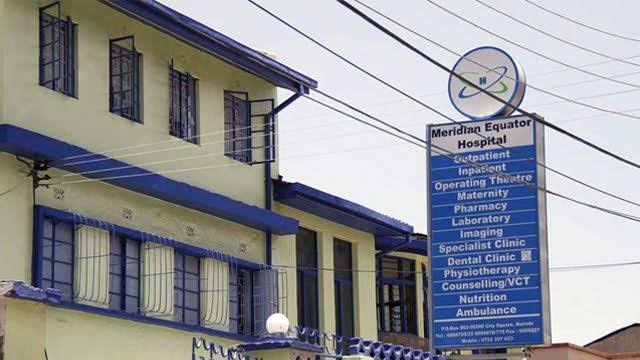

A tragic incident at Meridian Equator Hospital in South C, Nairobi, has raised serious questions about patient safety and medical care after a 32-year-old lawyer, Christopher Ntogaiti Mwenda, died while undergoing what his family understood to be a routine medical procedure.
Christopher had gone to the hospital seeking help for mild stomach pain and loose stools, symptoms that did not appear serious at the time. What was expected to be a simple check-up ended in loss of life, leading to an investigation by the Directorate of Criminal Investigations to establish what went wrong.
Christopher visited the hospital on December 17, 2025, after experiencing discomfort for a short time. Tests carried out that day showed no major problems.
Doctors ruled out serious infections such as H. pylori and did not find anything alarming. He was given medicine to manage pain and reduce stomach irritation. Before leaving, doctors advised him to return the following day for an endoscopy.
The procedure was explained as routine and meant to help doctors get a clearer picture of what might be causing his discomfort. The family was reassured that there was no cause for concern.
On December 18, Christopher returned to the hospital feeling well. He spoke to his family before the procedure and did not show signs of distress. His brother, Joram Muriuki, was listed as the emergency contact.
Around midday, Joram received a call from the hospital asking him to come immediately. No explanation was given over the phone. When he arrived, hospital staff were unclear and avoided giving direct answers about Christopher’s condition, which increased the family’s worry.
Several hours later, at about 3 pm, the family was informed that Christopher had died. The doctor in charge, Kevin Murimi, told them that problems started after Christopher was given propofol, an anesthetic commonly used to sedate patients during procedures.
According to the doctor, he administered 20 milliliters of the drug, after which Christopher’s blood pressure dropped, his heart rate increased, and his breathing became difficult.
Attempts were made to revive him through chest compressions and inserting a breathing tube, but after nearly an hour, he could not be saved.
The family demanded clear information and access to medical records, but the hospital did not provide these immediately. The body was not released until late at night, and only after intervention by the Law Society of Kenya, officers from the DCI in Lang’ata, and the government’s chief pathologist. This delay and lack of openness caused further distress.
A post-mortem examination was carried out on December 19 by three pathologists, including government pathologist Dr. Johansen Oduor. They agreed that Christopher died from lack of oxygen caused by slowed breathing after anesthesia.
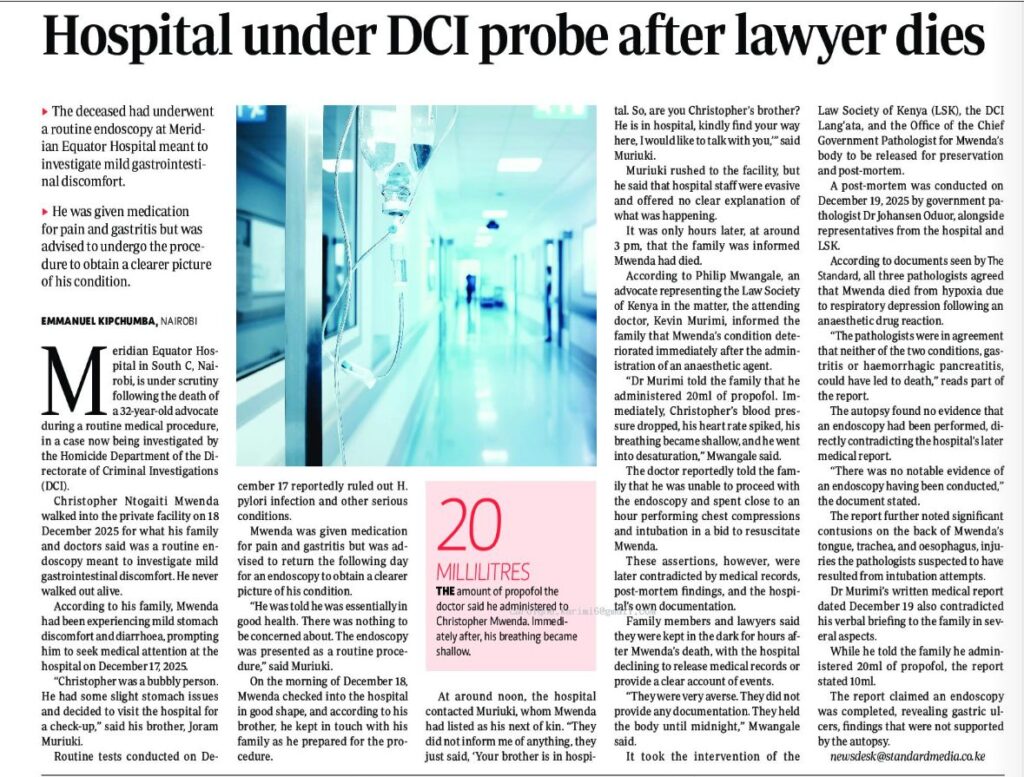
They ruled out stomach-related conditions as the cause of death, noting that while issues such as gastritis were present, they were not severe. The examination also found no evidence that an endoscopy had been performed, which contradicted the hospital’s report claiming the procedure was completed and ulcers were found.
There were also differences in the reported amount of propofol given, with written records stating 10 milliliters instead of the 20 mentioned earlier. Injuries found in the airway suggested difficulty during attempts to insert a breathing tube.
The family believes Christopher did not receive proper care and that the hospital failed to be honest. Through their lawyer, Philip Mwangale, they have pointed out the inconsistencies and delays. The DCI homicide team is now investigating to determine whether negligence or criminal responsibility was involved.
Christopher is remembered as a dedicated lawyer and a kind person. His family hopes the truth will come out and that lessons will be learned to improve patient safety.










Add Comment